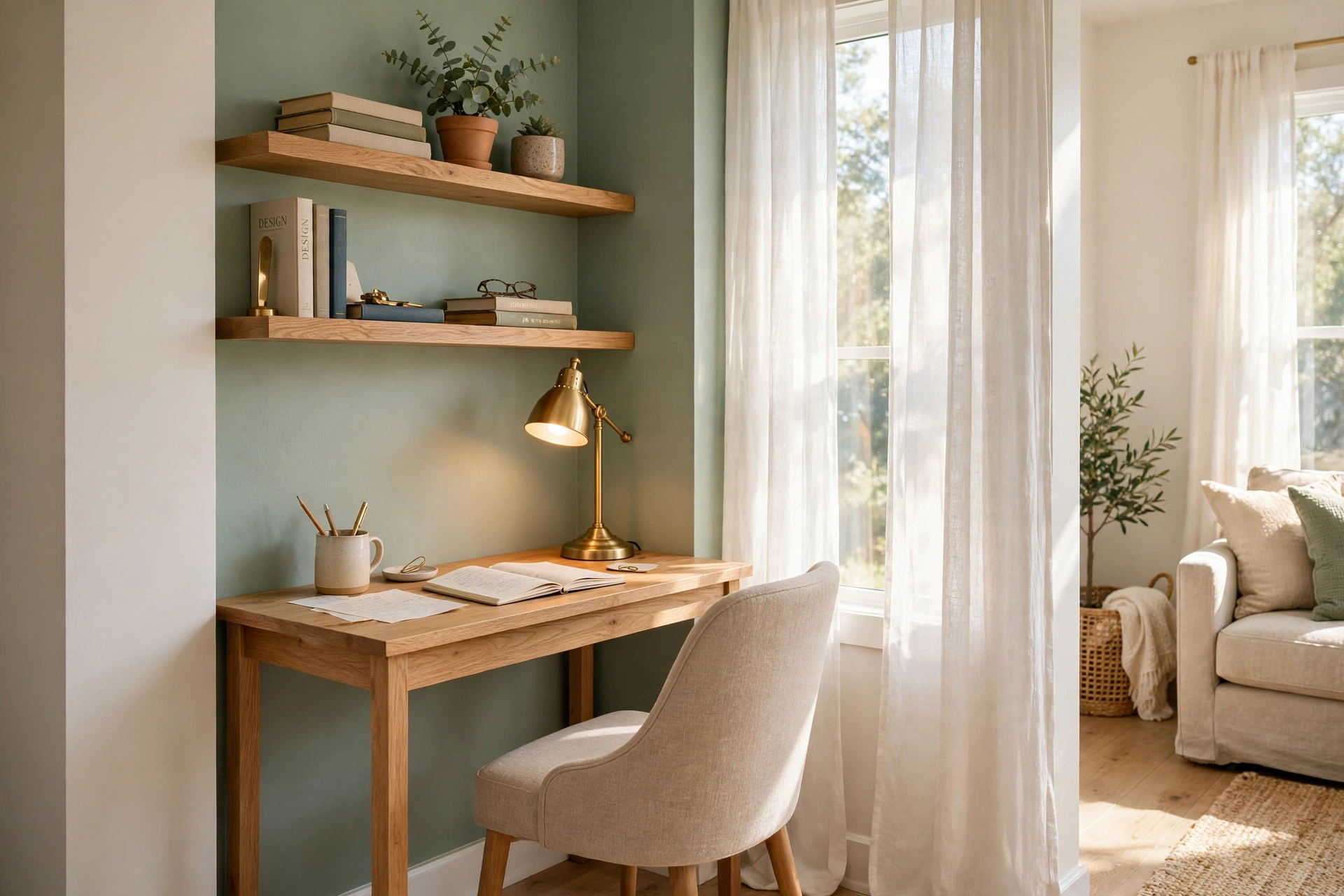
12 Budget Home Office Ideas for Small Spaces (That Look Designed, Not Cramped)
You don’t need a spare room to work from home well. You need about 4 feet of wall (1.2 m), a surface at the right height, and a setup you can mentally leave at the end of the day. I worked from a 38-inch (97 cm) desk shoved into a bedroom corner for two years, and the difference between the months it felt miserable and the months it felt fine came down to six things: light, storage off the desk surface, cable control, one good chair decision, and a boundary ritual.
These 12 budget home office ideas keep the total well under $150 each in most cases — many are under $50 — and together they form a small home office organization system designed for rooms where the office has to share space with your living room, bedroom, or kitchen.
What you actually need: the 7-piece essentials checklist
Before buying anything, check what you already own against this list — most people have four or five of these without spending a cent:
- A stable surface — desk, table, console, or a wall-mounted fold-down (28–30 in / 71–76 cm high for seated work).
- A chair you can sit in for 6 hours — adjustable height matters more than looks.
- Screen at eye level — a $20 laptop stand, or a stack of hardcover books for free.
- A keyboard and mouse — once the laptop is raised, you need separate input so your elbows sit at 90 degrees.
- Warm task lighting — a 2700K desk lamp aimed from a 45-degree angle.
- A power strip with surge protection — one strip mounted under the desk, not a tangle on the floor.
- Headphones with a mic — for calls; your laptop mic picks up every echo in a small room.
That’s the whole checklist. Everything else in this article is about making that kit fit a small space and look good doing it.
1. Steal 4 feet of wall, not a room
The biggest misconception about small home offices is that you need a lot of square footage. You need width, not depth. A desk 36–48 in (91–122 cm) wide and 18–24 in (46–61 cm) deep holds a laptop, a notebook, and a mug with room to spare. Measure the wall first, then buy or build to the measurement — not the other way around. In a 10 × 12 ft (3 × 3.7 m) bedroom, one 42-inch (107 cm) desk along the wall takes up less than 3% of the floor area.
2. The fold-down desk: an office that disappears
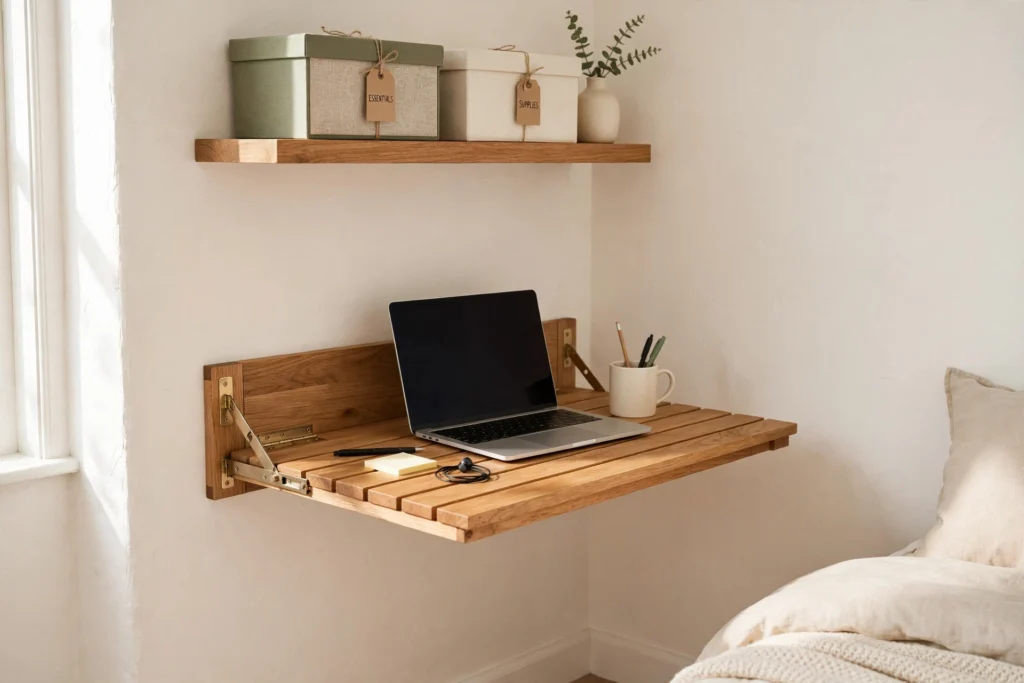
Wall-mounted fold-down desks cost $40–80 and give you a 30–36 in (76–91 cm) work surface that folds flat to about 5 in (13 cm) of wall depth when the workday ends. This is the single best solution if your desk has to live in a bedroom — closing it is a physical “work is over” gesture, and it removes the temptation to answer one more email from bed. Mount it at 28–30 in (71–76 cm) height for chair use, or 40–42 in (102–107 cm) for standing.
3. Build a cloffice (closet office)
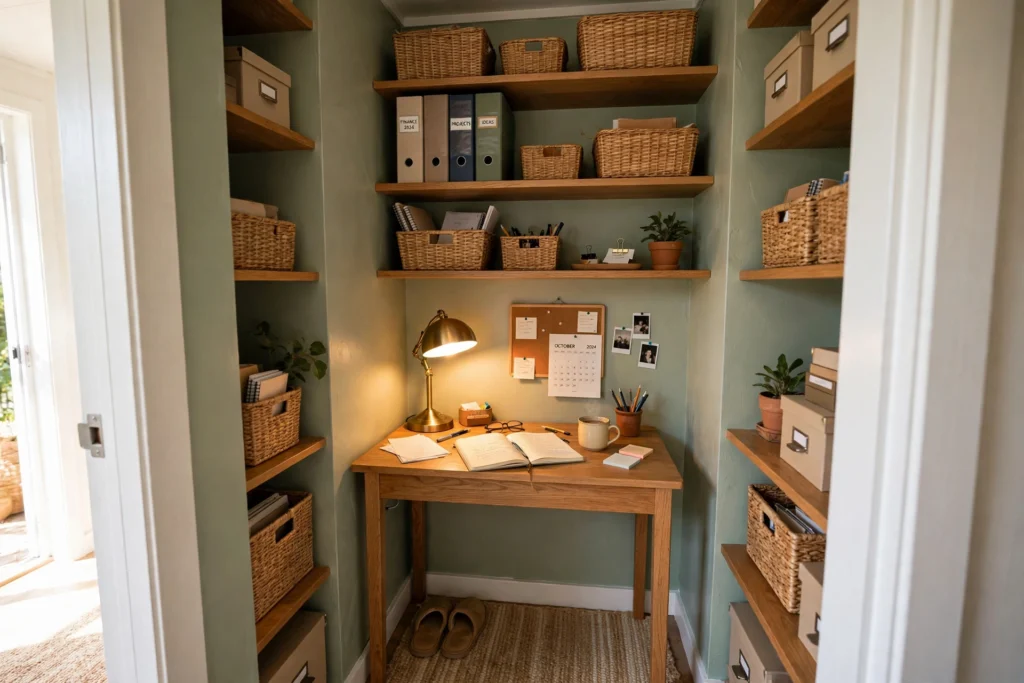
If you have a reach-in closet you barely use, you have an office waiting to happen. Remove the door (or leave it open), install a desktop across the opening at 29 in (74 cm), and add two shelves above. A standard 24-inch-deep (61 cm) closet is deep enough for a laptop and a monitor on an arm. The closet’s built-in boundaries solve the “work follows me everywhere” problem — you can literally close the door on your job. Add a $15 adhesive LED strip and the cave becomes a studio.
4. The living-room desk disguised as a console table
When the desk has to live in the living room, buy for disguise: a 14–16 in (36–41 cm) deep console table reads as furniture, not office equipment. Style the top with a lamp, a stack of books, and one plant; the laptop lives in a drawer or a slim sleeve when you’re off the clock. If your desk is going in the living room, borrow one trick from smart small living room layouts — anchor the work zone with a small rug so the office has a visible boundary instead of bleeding into the whole room.
5. Go vertical: store on the wall, work on the desk
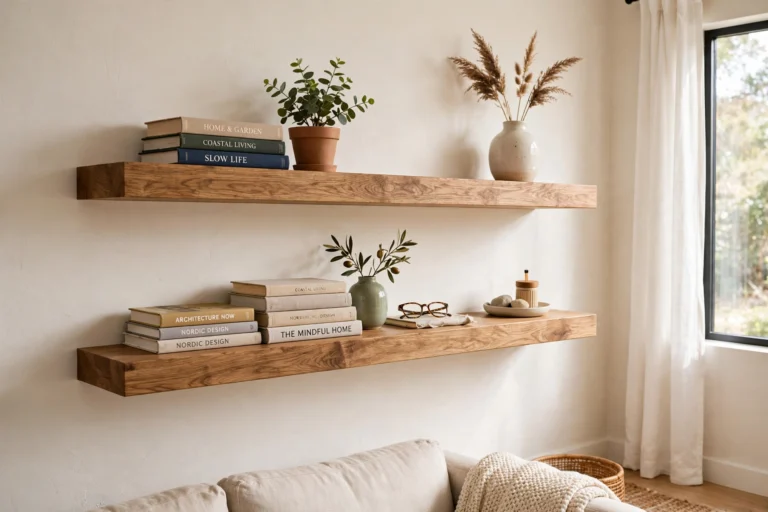
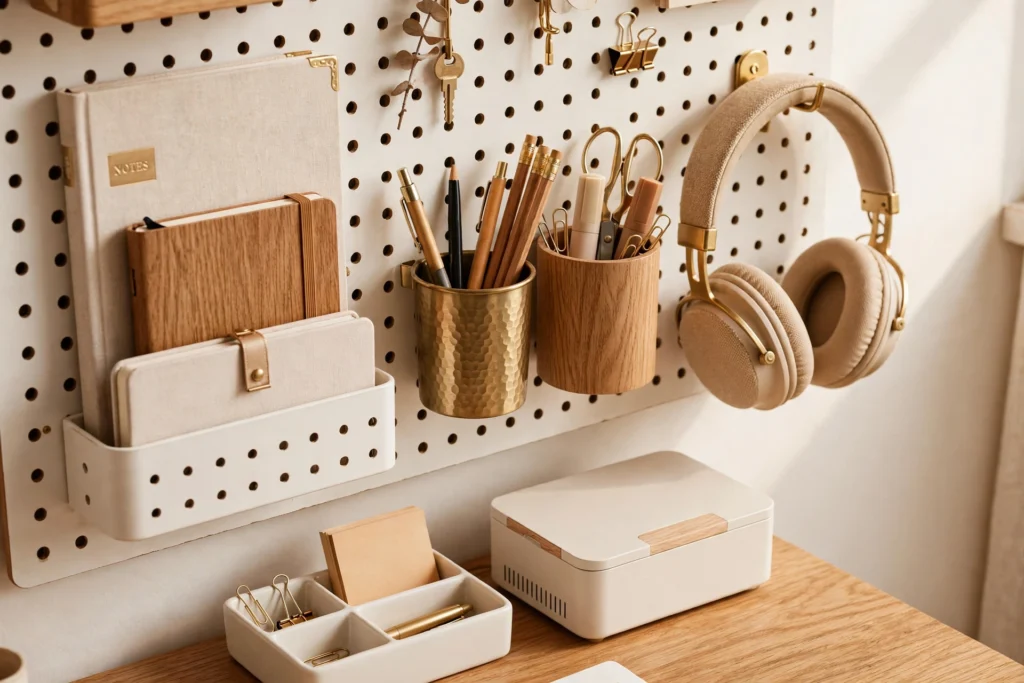
A desk stays usable only if storage lives somewhere else. Two floating shelves above the desk, a pegboard panel, or a wall-mounted file holder moves paper, chargers, and supplies off the work surface for under $30. Rule of thumb: if you touch it daily, it earns shelf space at arm’s reach; everything else goes in a box on the top shelf. This is the same principle our whole-home organization guide uses — every category gets a home zone, and surfaces stay clear by default.
6. Let a bookshelf do two jobs
A low bookshelf (30–36 in / 76–91 cm tall) placed perpendicular to a wall creates a room divider that also holds office supplies, and the back of it can carry a cork board or a magnetic strip for notes. In studios and shared living rooms, this kind of soft zoning is what makes one room feel like two — which is exactly why it pairs so well with studio layout thinking. Total cost: one $35–60 bookshelf and ten minutes.
7. Cable control: the $10 upgrade that looks like $200
A tangle of cables under a desk makes any setup look cheap and chaotic. A $10 adhesive cable tray or a simple zip-tied fabric sleeve under the desk, plus one power strip mounted to the desk’s underside instead of the floor, transforms the whole corner. Route the monitor or laptop charger, the lamp cord, and one spare cable through the tray and you’re done. Ten minutes, biggest visual payoff per dollar in this entire list.
8. Light it like you mean it: warm task lighting
Overhead ceiling light is the enemy of the small office — it’s flat, harsh, and unflattering on video calls. A $20–35 desk lamp with a warm 2700K bulb aimed at your face from a 45-degree angle does more for your on-camera look than any webcam upgrade. Place the lamp on the opposite side from your window so your face gets light from two directions. If your corner gets no natural light at all, add a daylight-balanced LED panel behind the monitor — your eyes will thank you by 4 p.m.
9. The rolling-cart office
A three-tier rolling cart ($25–40) is a complete mobile office: top tier for laptop and current work, middle for supplies, bottom for paper and cables. Wheel it to the table or sofa when it’s work time, roll it into the closet or behind the door when it isn’t — the same hideaway logic behind clever tiny entryway ideas that keep a small home feeling calm instead of cluttered. For renters and sharers, this is the lowest-commitment office on the list.
10. Claim the kitchen corner for morning light
Kitchens get the best morning light in most small homes, and a 30-inch (76 cm) section of counter or a small bistro table makes a perfectly good 9-to-12 workspace. The rules: a laptop stand so the screen hits eye level, a cushion on the hard chair, and a strict pack-up at lunch so the kitchen goes back to being a kitchen. Not a full-time office — but a free, bright one for half the day.
11. Spend the money on the chair, not the desk
If your budget has one splurge, make it the seat. A $30 desk with a $120 ergonomic chair beats a $150 desk with a dining chair every time — your back keeps the score. Look for adjustable seat height, lumbar support, and a seat pan at least 17 in (43 cm) deep. For truly tiny footprints, a good saddle stool or a kneeling chair takes up less space than a full office chair and stores under the desk.
12. Build a shutdown ritual into the space
The hardest part of a bedroom-corner or living-room office isn’t the setup — it’s the boundary. Pick a 5-minute end-of-day ritual: close the laptop, clear the desk surface, fold the desk down or roll the cart away, change the lamp off. Your brain learns that the ritual means work ended, even when the desk is six feet from the sofa. Bedroom-corner desks work best when the rest of the room already runs on good small bedroom storage tricks — a calm room makes a calm office, and vice versa.
A sample $120 setup (everything included)
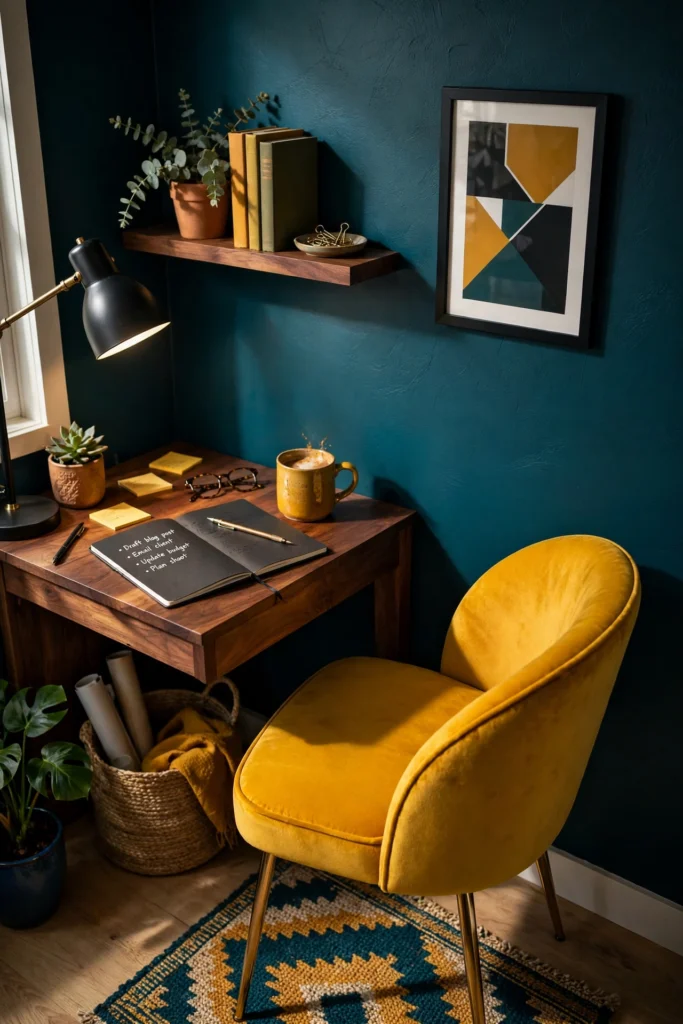
To make the budget real: a secondhand or basic desk ($40), a thrifted but adjustable chair ($30), a warm LED desk lamp ($20), an adhesive cable tray plus a power strip ($15), and two floating shelves with brackets ($15). That’s a complete, good-looking, good-feeling home office for $120 — in about 4 feet of wall.
How much does a small home office cost on a budget?
About $120–350 for a complete setup. If you already own a laptop and a chair, the essentials — a warm desk lamp, a cable tray, wall shelves, and a laptop stand — run under $70. Starting from zero with a basic desk, a secondhand ergonomic chair, and the lighting and storage here, expect roughly $150–230; a fuller build with a used monitor lands near $300.
Can I set up a home office in a bedroom corner?
Yes — a corner is actually ideal. Two walls give you vertical storage on both sides, and a 36–48 in (91–122 cm) desk fits without crowding the bed. Keep the desk perpendicular to the window for the best light, and consider a fold-down desk or a rolling cart if the room doubles as a guest room.
What do I actually need for a home office setup?
Seven things: a stable surface, a chair you can sit in all day, your screen at eye level, a separate keyboard and mouse, warm task lighting, a surge-protected power strip, and headphones with a mic. Every purchase beyond that is comfort or looks — this checklist is the minimum that actually works.
How do I make a small home office look good on video calls?
Put a warm 2700K desk lamp at a 45-degree angle to your face, keep the background simple (one styled shelf or a plant, not clutter), and face a window or light source when you can. A tidy background and good lighting matter more than an expensive webcam.