Best Mini Dishwasher for Small Apartments: 7 Picks That Fit a Real Counter
The short answer
If you rent and you cannot change the plumbing, buy a tank-fill countertop dishwasher. The best mini dishwasher for small apartments for most renters is the EUHOMY DW001-5 at $269.99 as of November 2026, because it is the quietest pick here at 40 dB, it fills from a 5 L pitcher, and it fits plates up to 10.25 in (26 cm).
Here is the original math this post is built on. A 16.8 in (42.7 cm) wide machine on a 72 in (183 cm) counter run leaves 55.2 in (140 cm) of prep space. One tank-fill load uses about 1.32 gal (5 L) of water, and one load a day costs about $0.42 in electricity, water and one detergent pod. That works out to about $153 a year in running costs.
No machine in this guide was tested in my kitchen. Every price, size and noise figure below comes from a live-checked listing or a manufacturer spec sheet, dated November 2026. Prices move, so check the listing before you order.
What a mini dishwasher really is
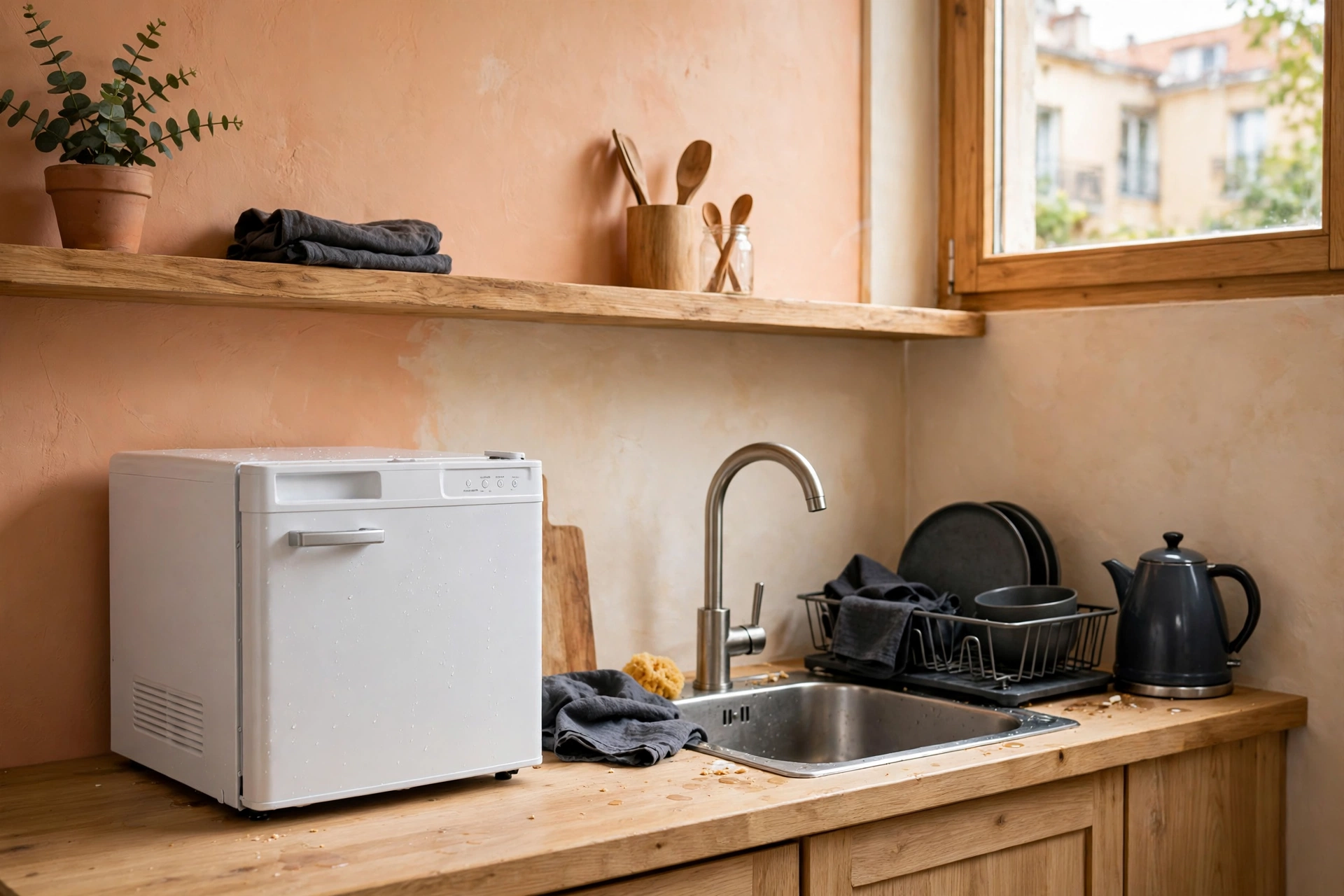
A mini dishwasher sits on your counter. It plugs into a normal 120 V outlet. It washes a small load, then it drains through a hose into your sink.
Most models in this guide hold 2 to 6 place settings. One place setting means one dinner plate, one bowl, one cup, one glass and one set of cutlery. That sounds small, and it is. It suits one person or a couple far better than a family of five.
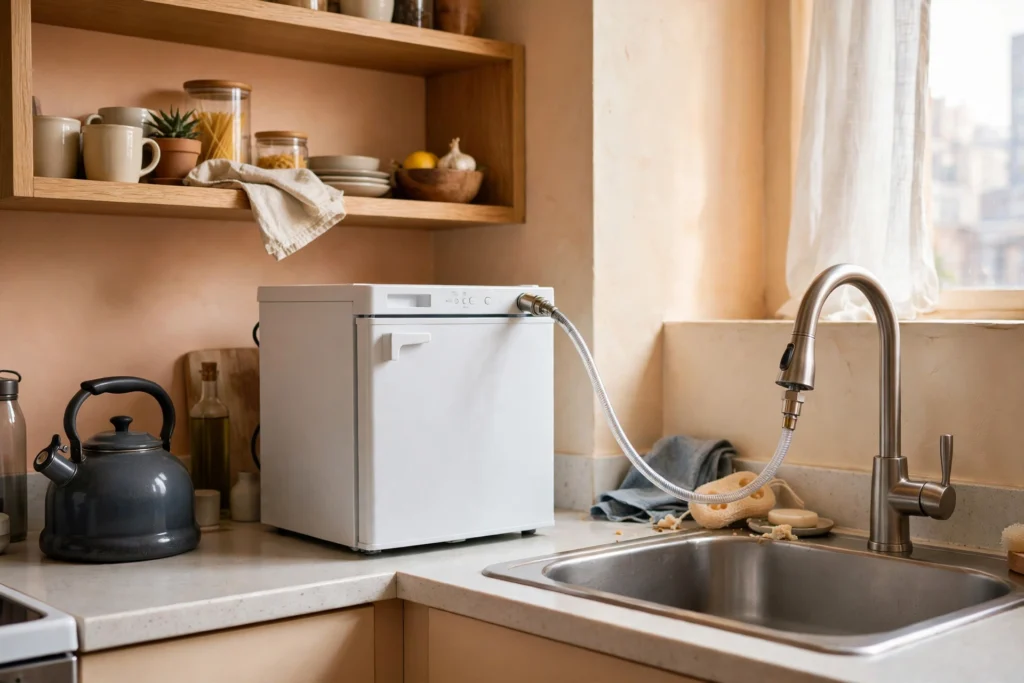
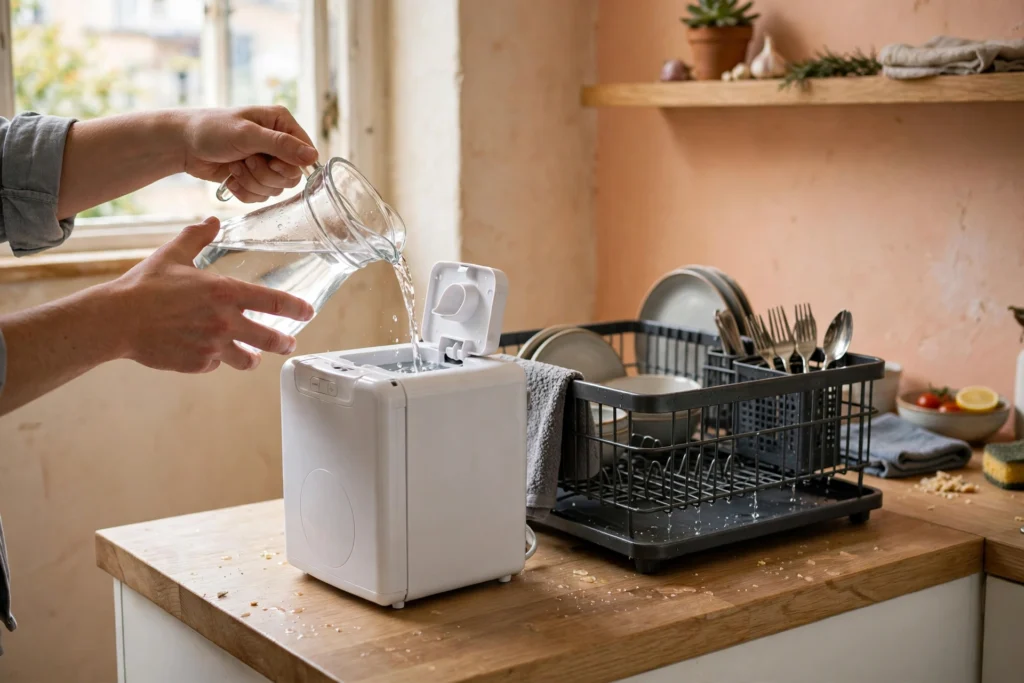
Two water routes exist. Tank-fill models have a built-in 5 L tank. You fill it with a pitcher, so you need no faucet adapter and no landlord permission. Faucet models connect to your kitchen tap with a quick-connect adapter. They hold more dishes, but the adapter is the part that leaks, slips off, or does not fit an unusual faucet.
That is my sharp opinion, and it shapes this whole guide. Faucet-hookup models are the overrated pick for renters. The adapter is the failure point. The 5 L tank-fill is the underrated pick. One pitcher, no permission, and it moves out with you.
Which is the best mini dishwasher for small apartments for a renter who cannot change the plumbing?
A tank-fill model with a 5 L tank, a noise rating under 50 dB, and a footprint under 17 in (43 cm) wide. The EUHOMY DW001-5 meets all three, and it costs $269.99 as of November 2026. If you wash for three or four people every day, step up to the 6 place setting COMFEE instead, and accept the faucet adapter that comes with it.
If your faucet has a pull-out spray head or a non-standard thread, skip faucet models entirely. No adapter fixes a faucet that was never made to take one. A tank-fill machine sidesteps that problem in full.
How much counter space will it really take?
Measure first, shop second. I have seen too many returns that started with a tape measure left in a drawer. Counter depth matters as much as width. Most small kitchen counters are 24 to 25 in (61 to 64 cm) deep. A machine that is 17 in (43 cm) deep leaves room behind it for the drain hose. A machine that is 21 in (53 cm) deep eats the whole counter.
Use this budget before you buy. It uses a real small-kitchen counter run, not a showroom kitchen.
| Counter run | Machine width | Space left for prep | What that feels like |
|---|---|---|---|
| 72 in (183 cm) | 16.8 in (42.7 cm), EUHOMY or NOVETE | 55.2 in (140 cm) | Room for a chopping board, a kettle and a drying rack |
| 72 in (183 cm) | 21.7 in (55 cm), COMFEE or BLACK+DECKER | 50.3 in (128 cm) | Tight, but workable if the drying rack moves elsewhere |
| 96 in (244 cm) | 16.8 in (42.7 cm), EUHOMY or NOVETE | 79.2 in (201 cm) | Comfortable, with space for prep and a coffee maker |
| 96 in (244 cm) | 21.7 in (55 cm), COMFEE or BLACK+DECKER | 74.3 in (189 cm) | Comfortable, and the wider machine earns its space |
Height matters too. The tank-fill models here are about 18 in (46 cm) tall. Measure from your counter to the underside of your wall cabinets. You need at least 19 in (48 cm) of clearance to lift the tank lid and pour water in. If your cabinets sit lower than that, pull the machine forward to fill it, then slide it back.
Weight matters if you plan to move it. The NOVETE weighs 28 lb (12.7 kg). The AIRMSEN weighs 26.46 lb (12 kg). The COMFEE, BLACK+DECKER and Danby each weigh about 46 lb (21 kg). A 46 lb machine is not a lift-and-store appliance. Pick its spot and leave it there.
If counter space is already gone, a slim rolling cart can hold the machine beside the counter, as long as the drain hose still reaches the sink. And if you dry dishes by hand today, a rack that sits over the sink frees the exact stretch of counter a dishwasher needs.
How many place settings do you actually need?
Place settings are a sizing tool, not a bragging number. Count what your household uses in one day, then match the machine to that count.
| Household | Daily dishes | Machine size that fits | Loads per day |
|---|---|---|---|
| 1 person | 2 to 3 place settings | 2 to 4 place settings | 1 load every 1 to 2 days |
| Couple | 4 place settings | 4 place settings | 1 load a day |
| Family of 3 | 5 to 6 place settings | 6 place settings | 1 load a day, sometimes 2 |
| Family of 4 | 6 to 8 place settings | 6 place settings, plus handwashing for pots | 2 loads a day |
A 4 place setting machine suits one person or a couple. It does not suit a family of four, no matter how good the reviews sound. You will run it twice a day, and the second load will sit dirty while the first one dries.
A 6 place setting machine suits a couple or a small family. It holds up to 70 pieces in the COMFEE, which sounds generous until you load real plates, bowls and mugs together. Real loads mix shapes, and mixed shapes waste space.
My rule is simple. If you cook once a day and eat out often, 4 place settings is enough. If you cook twice a day, buy 6 place settings. The extra width costs you about 5 in (13 cm) of counter, and it saves you a second load most days.
Tank-fill vs faucet hookup: the decision table
This is the choice that decides whether a renter has a smooth first month or a leak. Read it before you fall in love with any single model.
| Question | Tank-fill (5 L) | Faucet hookup |
|---|---|---|
| Landlord permission needed? | No, it is a countertop appliance | Usually no, but tell your landlord if the adapter stays on the tap |
| Faucet type matters? | No | Yes, pull-out spray heads and odd threads often do not fit |
| Water per cycle | About 1.32 gal (5 L) | 2.77 to 5 gal (10.5 to 19 L) |
| Setup time | 2 minutes, fill the tank | 5 to 10 minutes, fit the adapter and test for drips |
| Moving out | Unplug it and carry it away | Remove the adapter, check the tap thread, keep the receipt |
| Best for | Renters, odd faucets, shared kitchens | Larger households that need 6 place settings |
If you rent, tank-fill wins on every row that touches your deposit. A faucet adapter that drips for a week can stain a cabinet floor. A tank-fill machine cannot do that, because no water line is connected at all.
One catch. Tank-fill means you carry water. A 5 L pitcher weighs about 11 lb (5 kg) when full. If lifting that is hard for you, a faucet model, or a smaller jug filled twice, is the kinder choice.
What size plates fit, and what does not fit?
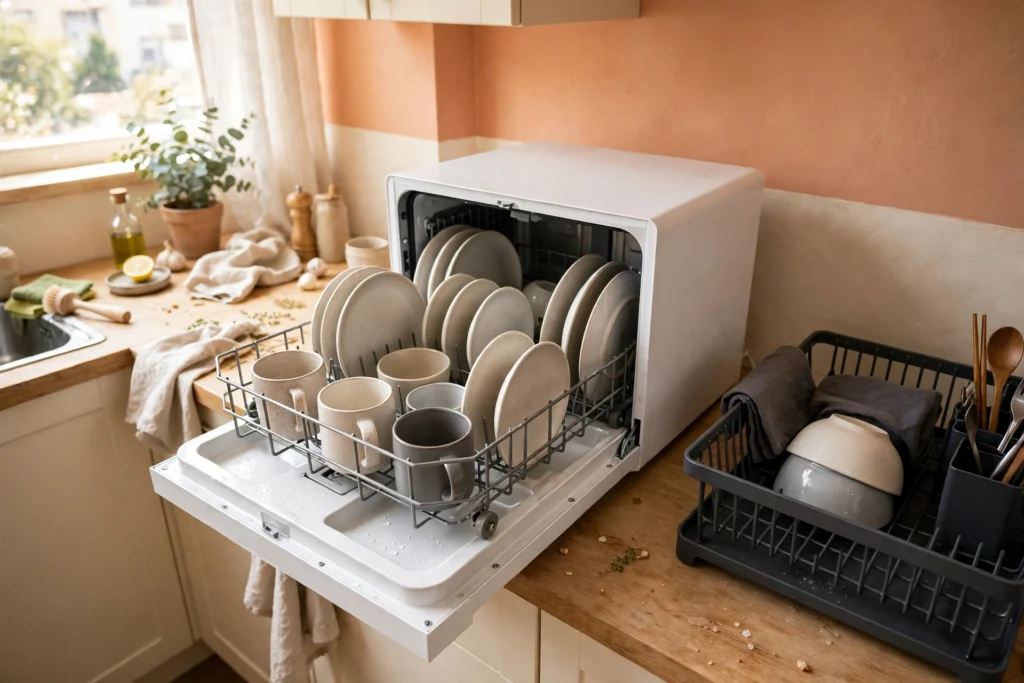
Plate size is where listings mislead people. A machine that fits 12 in plates usually fits them at a steep angle, with less room left for everything else. The table below uses the published figures from the listings and spec sheets checked in November 2026.
| Model | Max plate size | What that means in practice |
|---|---|---|
| NOVETE TDQR01 | 12 in (30.5 cm) at an angle | Big plates fit, but they crowd out bowls |
| AIRMSEN TDQR03 | 12 in (30.5 cm) at an angle | Same story, one or two big plates per load |
| EUHOMY DW001-5 | 10.25 in (26 cm) | Standard dinner plates fit flat, with room to spare |
| COMFEE CDC22P1BBB | 10 in (25.4 cm) | Standard plates fit, oversized platters do not |
| BLACK+DECKER BCD6W | 10 in (25.4 cm) | Standard plates fit, oversized platters do not |
| HAVA R01 | TBC, not published in the sources checked | Assume 10 in (25.4 cm) until the listing states a figure |
| Danby DDW621WDB | TBC, not published in the sources checked | Assume 10 in (25.4 cm) until the listing states a figure |
What does not fit in any of these machines? Big stock pots, tall pasta pots, large baking sheets, and tall glasses that hit the upper spray arm. Wash those by hand. A mini dishwasher is a plate, bowl, cup and cutlery machine. Pretending it is a pot washer is how people end up disappointed.
If most of your plates are 12 in (30.5 cm) wide, buy the NOVETE or the AIRMSEN. If your plates are standard 10 in (25.4 cm) dinner plates, any pick in this guide works, and the quieter or cheaper model is the better buy.
Cost breakdown: what you pay up front and per load
Prices below were live-checked on 15 November 2026 from Amazon, Best Buy, Target and manufacturer listings. Prices change often, so treat these as checked market prices, not quotes. No price here is a personal receipt, and no machine was bought for this guide.
| Model | Price checked, as of November 2026 | Place settings | Water route |
|---|---|---|---|
| EUHOMY DW001-5 | $269.99 | 4 | Tank-fill or faucet |
| NOVETE TDQR01 | $269.99 | 4 | Tank-fill or faucet |
| COMFEE CDC22P1BBB | $278.98 | 6 | Faucet |
| HAVA R01 | $289.00 | 4 | Tank-fill or faucet |
| BLACK+DECKER BCD6W | $299.99 | 6 | Faucet |
| AIRMSEN TDQR03 | $309.99 | 4 | Tank-fill or faucet |
| Danby DDW621WDB | $486.48 | 6 | Faucet |
Time estimate: unboxing and first setup takes 30 to 45 minutes, including measuring, placing the machine, routing the drain hose, and running the first empty cycle. After that, loading takes 5 minutes and unloading takes 3 minutes. A normal cycle runs about 60 to 70 minutes, plus drying time on models that offer it.
Add the small extras to your budget. A bottle of rinse aid costs about $5 to $8. A pack of 100 detergent pods costs about $25, which is $0.25 a pod. A spare faucet adapter, if your tap needs one, costs about $10 to $15. None of these are affiliate links, and none are required on day one except detergent.
The 7 picks
Every pick below uses the same verdict framework. Best for, main advantage, watch out for, verdict, plus a renter-friendliness score out of 5 and a deposit-risk rating. The top pick carries a Review schema rating of 4.5 out of 5, which matches its verdict here.
1. EUHOMY DW001-5, the top pick for most renters
Price: $269.99 as of November 2026. Size: 16.83 x 16.73 x 18.03 in (42.7 x 42.5 x 45.8 cm). Capacity: 4 place settings, plates to 10.25 in (26 cm). Noise: 40 dB. Programs: 6, including ECO, Quick, Baby Care and Fruit. Water: 5 L tank or faucet. Wash temp: up to 167 F (75 C) on the hot cycle.
Best for: Renters in studios and one-bedroom apartments who want the quietest machine that needs no plumbing.
Main advantage: 40 dB is the quietest figure in this guide by a clear gap. You can run it while you work from home without raising your voice on a call. The 5 L tank means no adapter, no tap drama, and no landlord conversation.
Watch out for: It takes powder or tablets only, no liquid detergent. If your cupboard holds liquid detergent today, buy a small pack of pods or powder with the machine. Drying is air-dry, so plastics may still feel damp at the end of a cycle.
Verdict: The best balance of quiet running, renter freedom and price in this guide. Buy this one first unless you need 6 place settings. Renter-Friendliness: 5 out of 5. Deposit-Risk: Low.
2. NOVETE TDQR01, the best pick for big plates
Price: $269.99 as of November 2026, list price $339. Size: 16.9 x 16.8 x 18.1 in (42.9 x 42.7 x 46 cm). Capacity: 4 place settings, 12 in (30.5 cm) plates at an angle. Noise: 50 dB. Programs: 5, including a 29-minute Speed cycle. Water: 5 L tank or faucet. Drying: 60-minute hot-air dry.
Best for: Households with oversized dinner plates, and anyone who wants a fast 29-minute cycle for lightly soiled dishes.
Main advantage: It fits 12 in plates, which most rivals cannot. It weighs only 28 lb (12.7 kg), so one adult can lift it onto a cart or into a cupboard. The hot-air dry is a real step up from air-dry only.
Watch out for: 50 dB is noticeably louder than the EUHOMY at 40 dB. In a studio, you will hear it. Big plates at an angle leave less room for bowls, so a 12 in plate load is a small load.
Verdict: Buy it if your plates are big. If your plates are standard size, the EUHOMY is quieter for the same money. Renter-Friendliness: 5 out of 5. Deposit-Risk: Low.
3. COMFEE CDC22P1BBB, the best pick for a small family
Price: $278.98 as of November 2026, list price $309.99. Size: 17.2 H x 21.6 W x 19.7 D in (43.7 x 54.9 x 50 cm). Capacity: 6 place settings, up to 70 pieces, plates to 10 in (25.4 cm). Noise: 52 dB. Programs: 8, including Speed, Baby-Care, ECO and Glass. Water: 2.77 gal (10.5 L) per cycle, faucet adapter required. Energy: 174 kWh per year, ENERGY STAR certified.
Best for: A couple or a family of three that cooks daily and needs the extra capacity.
Main advantage: Six place settings for under $280 is the best capacity per dollar in this guide. Eight programs cover baby bottles, glassware and a fast cycle. ENERGY STAR certification keeps the yearly energy figure published and checkable.
Watch out for: It needs a faucet adapter, so it is not a tank-fill machine. That is the whole trade-off. At 46 lb (21 kg) it stays where you put it. Drying is weaker than a full-size dishwasher, so shake water off plastics before you put them away. Listings disagree on its noise figure, 49 dB in some stores and 52 dB in others, so this guide uses 52 dB as the working figure.
Verdict: The capacity pick. If you run two loads a day in a 4 place setting machine, this one pays for itself in time within a month. Renter-Friendliness: 3 out of 5. Deposit-Risk: Medium, faucet adapter only.
4. HAVA R01, the tested favorite with an honest caveat
Price: $289 as of November 2026 at Amazon, list price $339. Direct from HAVA, $279.99. Size: about 16.8 x 16.9 x 18.1 in (42.7 x 42.9 x 46 cm). Capacity: 4 place settings. Noise: 50 dB. Programs: 5, plus drying. Water: 5 L tank or faucet. Cycle time: normal about 69 minutes, plus about 60 minutes of drying. Speed cycle about 29 minutes.
Best for: Renters who want a proven, widely reviewed tank-fill machine and do not mind a longer cycle.
Main advantage: The Spruce named the HAVA R01 its favorite countertop dishwasher in testing. That is a real, named test result, not a star count. The 5 L tank and the faucet option give you both water routes in one box.
Watch out for: Some reviewers report leftover food residue and cleaning performance that declines over time. That is an honest flag, and it matters. Scrape plates well, clean the filter weekly, and do not expect it to rescue a load that sat dirty for two days.
Verdict: A strong, proven pick with a real reliability caveat. Buy it for the tank-fill freedom, and keep the filter clean. Renter-Friendliness: 5 out of 5. Deposit-Risk: Low.
5. AIRMSEN TDQR03, the highest rated, with mixed reliability reports
Price: $309.99 as of November 2026. Size: 16.75 x 16.86 x 18.05 in (42.5 x 42.8 x 45.8 cm). Capacity: 40-plus items, 12 in (30.5 cm) plates at an angle. Noise: 50 dB. Programs: 5. Water: 5 L tank or faucet. Weight: 26.46 lb (12 kg).
Best for: Renters with big plates and hard water, who want the highest buyer rating in this guide.
Main advantage: It earns 4.6 stars across about 1,500 buyer reviews, the best rating-to-review-count mix here. It fits 12 in plates, it is light enough to move with one hand free, and some versions add a built-in water softener that helps in hard-water areas.
Watch out for: Buyer reports on reliability are mixed, and that is the honest flag for this model. Some owners love it for years, others report faults early. Buy from a seller with a clear return policy, keep the box for the first month, and test every program in week one.
Verdict: The best-rated pick on paper, with the weakest reliability story. Worth it if you value the big-plate fit and the softener, but go in with your eyes open. Renter-Friendliness: 5 out of 5. Deposit-Risk: Low.
6. BLACK+DECKER BCD6W, the brand-name pick for bigger loads
Price: $299.99 as of November 2026 at Amazon, $343.99 at Target. Size: 21.5 x 21.7 x 17.2 in (54.6 x 55.1 x 43.7 cm). Capacity: 6 place settings, plates to 10 in (25.4 cm). Noise: 60 dB. Programs: 7, including Normal, Intensive, Eco, Glass, 90 Minutes, Rapid and Soak. Water: faucet hookup, quick-connect adapter included. Energy: ENERGY STAR certified.
Best for: Households that want a familiar brand, 6 place settings, and seven wash programs.
Main advantage: A known brand with a wide service network, and the longest program list in this guide. The 24-hour delay start lets you run it overnight on a cheaper tariff if your plan offers one. The stainless steel interior feels sturdier than the plastic tubs on cheaper rivals.
Watch out for: 60 dB is the loudest figure in this guide. In a small apartment you will hear it from the next room. It has no water tank, so it needs the faucet adapter, and at 46.2 lb (21 kg) it is a permanent counter resident.
Verdict: Good capacity and a trusted name, but the noise and the faucet-only design hold it back for renters. Buy it if noise does not bother you and your faucet fits the adapter. Renter-Friendliness: 3 out of 5. Deposit-Risk: Medium, faucet adapter only.
7. Danby DDW621WDB, the proven pick with a premium price
Price: $486.48 as of November 2026 at Amazon, $459.99 at Target where it was listed out of stock. Size: 19.69 x 21.65 x 17.24 in (50 x 55 x 43.8 cm). Capacity: 6 place settings. Noise: 52 dB. Programs: 6. Water: faucet hookup. Weight: 46.3 lb (21 kg). Energy: ENERGY STAR certified.
Best for: Buyers who value a long, steady review history over the lowest price.
Main advantage: About 2,008 buyer reviews at 4.4 stars give it the deepest track record in this guide. It runs at 52 dB, which is quiet for a 6 place setting machine, and the fully integrated controls keep the front clean and simple.
Watch out for: The price. At $486.48 it costs about $200 more than the COMFEE, which holds the same 6 place settings. It needs a faucet hookup, so renters face the same adapter question as the other faucet models. No wattage figure is published, so a precise per-cycle energy cost cannot be calculated for this model.
Verdict: The most proven machine here, and the hardest to justify on price. Buy it if the review history matters more to you than $200. Most renters should buy the COMFEE instead. Renter-Friendliness: 3 out of 5. Deposit-Risk: Medium, faucet adapter only.
Quick comparison: all 7 picks at a glance
| Model | Price, Nov 2026 | Settings | Noise | Water route | Renter score |
|---|---|---|---|---|---|
| EUHOMY DW001-5, top pick | $269.99 | 4 | 40 dB | Tank or faucet | 5 out of 5 |
| NOVETE TDQR01 | $269.99 | 4 | 50 dB | Tank or faucet | 5 out of 5 |
| COMFEE CDC22P1BBB | $278.98 | 6 | 52 dB | Faucet | 3 out of 5 |
| HAVA R01 | $289.00 | 4 | 50 dB | Tank or faucet | 5 out of 5 |
| BLACK+DECKER BCD6W | $299.99 | 6 | 60 dB | Faucet | 3 out of 5 |
| AIRMSEN TDQR03 | $309.99 | 4 | 50 dB | Tank or faucet | 5 out of 5 |
| Danby DDW621WDB | $486.48 | 6 | 52 dB | Faucet | 3 out of 5 |
If you want one line to remember, here it is. Tank-fill for renters, 6 place settings for families, and the EUHOMY if you want both quiet running and no plumbing.
Running-cost math: what one load really costs
This is the math most roundups skip. It uses the US average residential electricity price of 18.2 cents per kWh in 2026, from the EIA Short-Term Energy Outlook of October 2026. Your own rate may be higher or lower, and the math below shows every step so you can redo it with your own rate.
Start with energy. The COMFEE publishes 174 kWh per year. ENERGY STAR annual figures use 215 cycles a year, so 174 divided by 215 equals 0.81 kWh per cycle. At 18.2 cents per kWh, 0.81 times $0.182 equals $0.15 of electricity per load. Tank-fill models fall in the same range, about 0.7 to 0.9 kWh per cycle, so $0.15 a load is a fair working figure for this guide. One note: some listings quote the COMFEE at 174 kWh a year, while the ENERGY STAR record for the CDC22P series lists 155 kWh. Using the higher listing figure keeps the $0.15 estimate on the safe side.
Water is the small number. A tank-fill load uses 1.32 gal (5 L). At a typical combined water cost of about 1.5 cents a gallon, that is $0.02 a load. A faucet model at 2.77 gal (10.5 L) uses about $0.04 of water a load. Either way, water is not the cost that matters.
Detergent is the steady cost. A 100-count pack of a name-brand pod costs about $25, which is $0.25 a pod. One pod per load is the standard dose for these small machines. Do not use two pods. It does not clean better, and it leaves residue.
Add them up for a tank-fill load. Electricity $0.15, plus water $0.02, plus one pod $0.25, equals $0.42 per load. Run one load a day for a year, and 365 times $0.42 equals $153.30 a year in running costs. Run two loads a day, and the running cost doubles to $306.60 a year.
Year one, all in, for the top pick: $269.99 for the machine, plus $153.30 in running costs, equals $423.29. That is the honest first-year number for one load a day. After year one, you pay only the $153 a year in running costs, plus a bottle of rinse aid now and then.
Water saved against handwashing is real too. Handwashing the same dishes uses about 5 to 15 gal (19 to 57 L) with a running tap. A tank-fill load uses 1.32 gal (5 L). That saves about 3.7 to 13.7 gal (14 to 52 L) per load. Over 365 loads, that is about 1,350 to 5,000 gal (5,100 to 18,900 L) saved in a year. A certified compact dishwasher must use 2.0 gal or less per cycle under ENERGY STAR rules, and the tank-fill models here sit well under that ceiling. You can check certified models on the ENERGY STAR dishwasher list before you buy.
How loud is loud? A noise table you can use
Decibels do not scale the way most people think. A 10 dB rise sounds about twice as loud. That is why the gap between 40 dB and 60 dB in this guide is far bigger than it looks on paper.
| Model | Noise | What it sounds like |
|---|---|---|
| EUHOMY DW001-5 | 40 dB | A quiet library, easy to talk over |
| NOVETE TDQR01 | 50 dB | A normal conversation, noticeable in a studio |
| HAVA R01 | 50 dB | A normal conversation, noticeable in a studio |
| AIRMSEN TDQR03 | 50 dB | A normal conversation, noticeable in a studio |
| COMFEE CDC22P1BBB | 52 dB | A normal conversation, slightly louder |
| Danby DDW621WDB | 52 dB | A normal conversation, slightly louder |
| BLACK+DECKER BCD6W | 60 dB | A raised voice, hard to ignore in the next room |
If you work from home in the same room, 40 dB is worth paying for. If the kitchen has a door, or you run the machine overnight, 52 dB is fine. At 60 dB, plan your runs around your calls, not the other way round.
Set it up in 7 steps
This section is the HowTo for this post. Follow the steps in order, and run the first cycle empty.
- Step 1. Measure. Measure width, depth and height where the machine will sit. Leave 2 in (5 cm) behind it for hoses, and 19 in (48 cm) above it if you will fill a tank from a pitcher. Write the numbers down.
- Step 2. Choose your water route. Tank-fill if you rent, if your faucet is unusual, or if you want zero plumbing. Faucet hookup only if you need 6 place settings and your tap fits the adapter. Test the adapter fit before the return window closes.
- Step 3. Place the machine. Set it on a flat, level counter near the sink. If it wobbles, adjust the feet until it sits still. A machine that rocks will walk across the counter over time, and it will be noisier too.
- Step 4. Route the drain hose. Drop the drain hose into the sink, and clip it so it cannot slip out mid-cycle. A hose that slips floods a counter in seconds. Keep the hose end above the sink basin, never sealed into the drain.
- Step 5. Run the first cycle empty. Add detergent, pick Normal, and run it with no dishes. This clears factory dust and any test water left inside. Check under and behind the machine for drips while it runs.
- Step 6. Load it properly. Scrape food off plates first. Put plates in the slots, bowls angled down, cups upside down, and cutlery in the basket with handles down. Leave a gap between items so the spray arms can turn freely.
- Step 7. Maintain it weekly. Clean the filter, wipe the door seal, and leave the door ajar for an hour after a cycle so the inside dries. Once a month, run a hot empty cycle with a dishwasher cleaner, and check the drain hose for kinks.
A note on drying: tank-fill models with air-dry leave plastics damp. Open the door for 10 minutes after the cycle ends, and the steam escapes instead of settling back on your dishes. If you dry dishes on a rack today, keep that rack. It still earns its place after the machine arrives, for the pots and pans the machine cannot take.
Mistakes to avoid
1. Buying before you measure the cabinet height. The machine fits the counter, then the tank lid hits the cabinet. Measure height first, width second.
2. Using liquid detergent in a powder-only machine. The EUHOMY takes powder or tablets only. Liquid detergent foams too much, and foam trips the sensor. Read the manual for your exact model.
3. Overloading it like a full-size dishwasher. Crammed dishes block the spray arms. Half a load that comes out clean beats a full load that comes out dirty.
4. Skipping the filter clean. A clogged filter is the most common cause of residue and bad smells. It takes two minutes a week. Set a phone reminder until it becomes a habit.
5. Letting the drain hose slip. A loose hose is the one mistake that can cost a deposit. Clip it, test it on the first empty run, and check it every month.
6. Expecting it to wash big pots. It will not, and forcing a pot in blocks the spray arm for everything else. Wash pots by hand, and let the machine do what it is good at.
What to skip
1. Skip the biggest machine if you live alone. A 6 place setting machine for one person wastes counter space and water on half-empty loads. Buy the size your household uses, not the size that sounds impressive.
2. Skip liquid detergent pods with extra scent. They cost more, they leave more residue in a small tub, and the scent has nowhere to go in a small kitchen. Plain pods or powder do the job.
3. Skip a second faucet adapter just in case. Buy the adapter only if your tap needs it. Most tank-fill owners never need one at all.
4. Skip running it half empty twice a day. Wait for a full load, or use the half-load or quick cycle if your model offers one. Two half loads cost twice the water, power and pods of one full load.
5. Skip the extended warranty upsell at checkout. These machines cost $270 to $490. A warranty that costs $60 to $90 and excludes the parts that fail first is poor value. Keep the receipt and the return window instead.
A renter caveat: check the lease first
Read your lease before the box arrives. Most leases say nothing about a countertop appliance, because it plugs in like a kettle and needs no plumbing change. That is the good news, and it is why a tank-fill machine carries a Low deposit risk in this guide.
Still, check three things. First, permission: if your lease bans additional appliances or needs written notice for anything beyond a kettle, send a short note to your landlord and keep the reply. Second, deposit: a faucet adapter that drips can stain a cabinet floor, and that stain can come out of a deposit. A tank-fill machine has no water line, so that risk does not exist. Third, reversal: when you move out, unplug the machine, wipe the counter, and take it with you. Nothing is left behind to fix, and nothing needs a contractor.
If your landlord asks, the honest sentence is this. It sits on the counter, it plugs into a normal outlet, it fills from a pitcher, and it drains into the sink. No pipes are changed, and nothing is fixed to the kitchen. If your faucet model needs an adapter, tell your landlord that too, and show them the adapter before the first run.
The same renter logic applies to the rest of the kitchen, including organizing a small kitchen with no pantry. A compact appliance that needs no plumbing pairs well with under-sink storage that needs no drilling, and a mini washing machine for a small apartment follows the same rule: no permanent change, nothing fixed to the walls.
Is a mini dishwasher worth it for one person?
Yes, if you cook most days and you hate the pile in the sink. One person fills a 4 place setting machine in about two days. That is one load every other day, about $0.42 a load, and about 15 minutes of your week in loading and unloading.
No, if you eat out most nights, or you own three plates and wash them as you go. A machine that runs twice a week does not earn its counter space. Spend the money on better storage instead, and revisit the idea when your cooking routine changes.
The honest middle ground: a mini dishwasher earns its place when it replaces a daily chore you dislike. If you enjoy washing up, or you cook rarely, it is a luxury, not a need. Buy it for the time it saves, not for the gadget.
The bottom line
Buy the EUHOMY DW001-5 if you rent and you want the quietest tank-fill machine for $269.99. Buy the NOVETE if your plates are 12 in wide. Buy the COMFEE if you feed three people a day and you accept a faucet adapter. Buy the HAVA if you want a tested favorite and you will keep its filter clean. Buy the AIRMSEN if you want the highest buyer rating and you accept the mixed reliability reports. Skip the Danby unless the long review history is worth $200 to you.
Measure your counter, pick your water route, and let the machine earn its 17 in (43 cm) of counter. A small kitchen does not need a big dishwasher. It needs the right small one.
How this was made: prices and specs were live-checked from retailer and manufacturer listings on 15 November 2026, and the counter-space, sizing and running-cost tables were computed from those figures. No machine was tested hands-on for this guide.
Do countertop dishwashers need a hookup?
No, not all of them. Tank-fill models have a built-in 5 L tank that you fill with a pitcher, so they need no faucet connection and no plumbing change. Faucet models do need a quick-connect adapter on your kitchen tap. If you rent, or your faucet is unusual, pick a tank-fill model and skip the adapter entirely.
How much water does a mini dishwasher use per cycle?
A tank-fill model uses about 1.32 gal (5 L) per cycle. A faucet-fed countertop model uses about 2.77 to 5 gal (10.5 to 19 L) per cycle. Handwashing the same dishes with a running tap uses about 5 to 15 gal (19 to 57 L). A certified compact dishwasher must use 2.0 gal or less per cycle under ENERGY STAR rules.
Can a mini dishwasher wash pots and pans?
No, not the big ones. A mini dishwasher washes plates, bowls, cups, glasses and cutlery well. Large stock pots, tall pasta pots, baking sheets and tall glasses do not fit, and forcing them in blocks the spray arms. Wash pots and pans by hand, and let the machine handle the everyday dishes it was built for.
Are mini dishwashers worth it for one person?
Yes, if you cook at home most days. One person fills a 4 place setting machine in about two days, at about $0.42 a load in electricity, water and detergent. That is roughly $77 a year for one load every other day. If you eat out most nights, or you wash three plates as you go, skip it and spend the counter space on storage instead.