8 DIY Nightstand Ideas for Small Bedrooms That Fit Gaps Under 16 Inches
A good nightstand in a small bedroom is not about the nightstand. It is about the gap beside the bed. Measure that gap first, and the right build picks itself. Most small bedrooms leave 10 to 16 inches (25 to 41 cm) between the bed and the wall, and a standard store-bought nightstand is 18 to 20 inches (46 to 51 cm) wide. That is why so many small bedrooms end up with a nightstand that blocks the walkway, or no nightstand at all. These 8 DIY nightstand ideas for small bedrooms are built around the gap you actually have, not the gap a furniture store assumes. Every build costs $40 or less, most take under two hours, and each one carries a renter-friendliness rating so you know before you start whether your deposit is safe.
How do you pick DIY nightstand ideas for small bedrooms?
Start with three numbers, and take them in this order. First, the gap between your bed frame and the wall, measured in inches. Second, the height of your mattress top, measured from the floor. Third, the walkway you need to keep clear, which is 24 inches (61 cm) at minimum. The gap decides the build, the mattress height decides the height, and the walkway decides whether the build stays or goes. Skip any one of these and you get the two classic small-bedroom mistakes: a nightstand you have to climb over, or one so low you knock your phone off it reaching down in the dark. The tables below turn those three numbers into a decision. Once you know your gap, jump straight to the build that matches it.
What size nightstand fits a small bedroom?
Two tables answer this. The first maps your measured gap to the build. The second maps your mattress height to the nightstand height and the leg length to buy.
Gap-width table: your gap decides the build
| Gap between bed and wall | What fits | Build to pick |
|---|---|---|
| Under 10 in (25 cm) | Wall only, nothing on the floor | Floating shelf, clip-on bed shelf, bedside caddy |
| 10 to 12 in (25 to 30 cm) | One slim shelf or a stool | Stool swap, single floating shelf |
| 12 to 16 in (30 to 41 cm) | A narrow table | Crate stack, hairpin-leg box |
| 16 to 20 in (41 to 51 cm) | A small nightstand | Hairpin-leg box, rolling cart |
| Over 20 in (51 cm) | A full small nightstand | Any build below, but keep 24 in (61 cm) of walkway |
Mattress-height table: your mattress decides the height
The rule every source agrees on is simple. The nightstand top should sit within 2 inches (5 cm) of the mattress top, and most nightstands land between 22 and 28 inches (56 and 71 cm) tall. Leg length is just the target height minus the thickness of the top.
| Mattress top height | Nightstand top target | Leg length to buy (3/4 in top) |
|---|---|---|
| 22 in (56 cm) | 20 to 24 in (51 to 61 cm) | 19.25 to 23.25 in |
| 24 in (61 cm) | 22 to 26 in (56 to 66 cm) | 21.25 to 25.25 in |
| 26 in (66 cm) | 24 to 28 in (61 to 71 cm) | 23.25 to 27.25 in |
| 28 in (71 cm) | 26 to 28 in (66 to 71 cm) | 25.25 to 27.25 in |
Worked example: your mattress top sits at 24 inches (61 cm). Pick a 24-inch nightstand top. With a 3/4-inch top, the legs need to be 23.25 inches long. Buy the nearest standard leg size at or below that, 22-inch legs, and the top lands 1.75 inches below the mattress, still inside the 2-inch rule. Or buy 24-inch legs and add felt pads under the feet. Either way, you decided with a tape measure, not a guess.
The lamp rule nobody sizes. A lamp on a 20 to 22 inch table should be 24 to 30 inches tall, base to shade top. On a narrow 12 to 14 inch nightstand, keep the lamp base under 6 inches wide, about half the nightstand width or less, so the shade does not overhang the edge and the whole thing does not tip when you reach for it half asleep. If your nightstand is under 14 inches wide, skip the table lamp entirely and use a clip-on light or a wall-mounted reading light instead.
The weight check before you load it. A floating shelf is only as strong as its fixing. One small-bedroom roundup rates a typical floating nightstand shelf at 30 lb (about 14 kg). A small acrylic bedside table is rated at 10 kg (22 lb), and a tinted acrylic shelf at just 3 kg (about 7 lb). Those are the makers’ stated ratings, not our tests, and they are the reason the floating shelf build below goes into a stud, never onto adhesive alone with a lamp on it. A lamp plus a book plus a phone is already 6 to 8 lb. Know the rating before you load the shelf, not after it comes down at 2 a.m.
The 8 best DIY nightstand ideas for small bedrooms
Every build below gets the same four lines: who it suits best, its main advantage, what to watch out for, and a verdict, plus a Renter-Friendliness rating from 1 (drilling required) to 5 (zero trace when you move out). All eight of these DIY nightstand ideas for small bedrooms cost $40 or less, and most take under two hours to build.
1. The crate stack
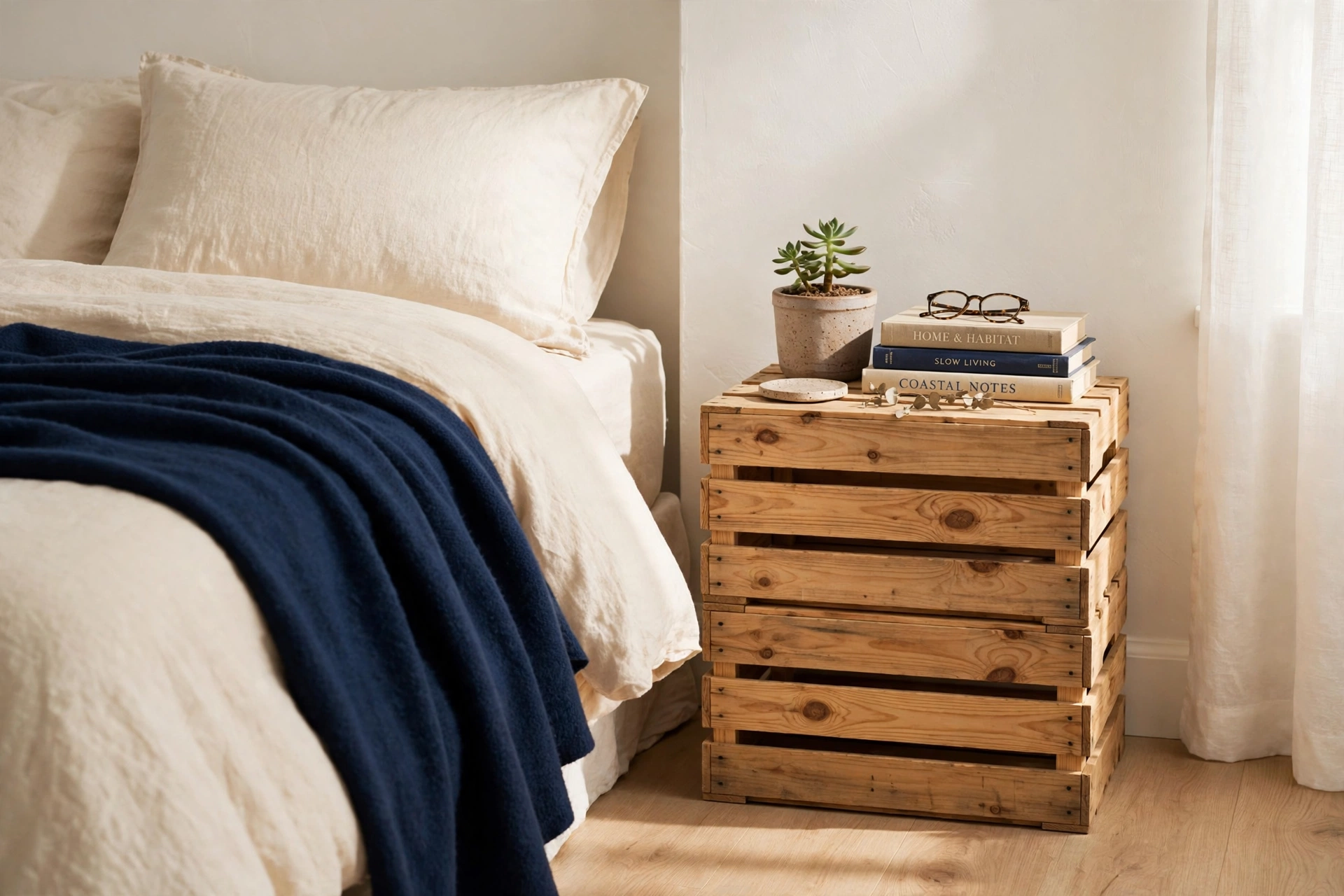
Two wooden crates, one on top of the other, open side facing out. It is the fastest build on this list and the best first build if you have never built anything. Sand the rough edges, stack them, and you have a nightstand with two open cubbies for books and a phone charger. Paint it the wall color and it reads as built-in rather than improvised.
Best for: first-time builders and anyone who wants storage, not just a surface. Main advantage: 15 minutes, no tools beyond sandpaper, and the cubbies hold more than a drawer. Watch out for: crates vary in size, so measure before you buy, and a wobbly stack needs a screw through the back to hold it together. Verdict: the best first build. Renter-Friendliness: 5/5. Nothing touches the wall.
2. The hairpin-leg plywood box
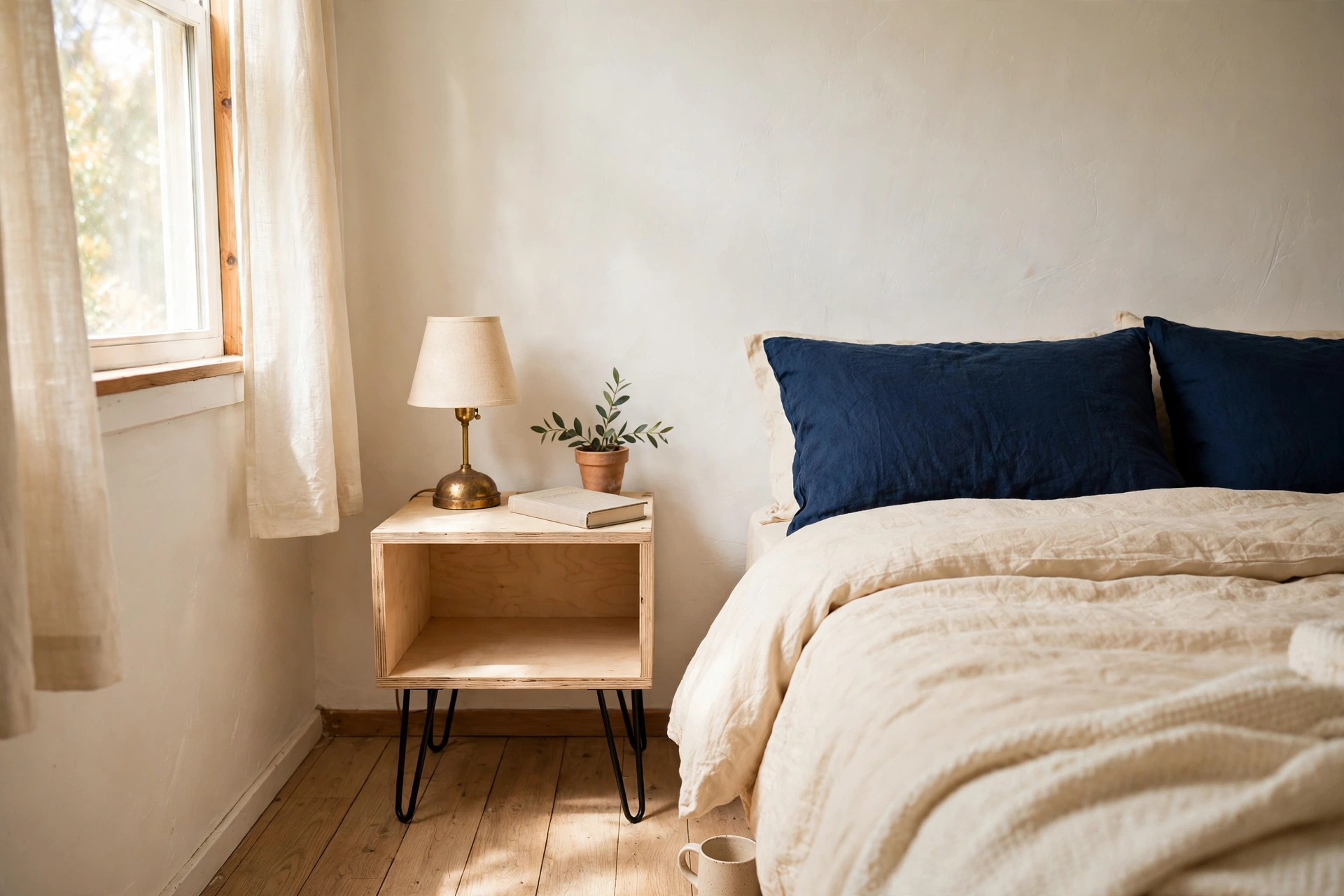
A simple plywood box, open at the front, sitting on four 16-inch hairpin legs. This is the best-looking build for the money on this list. The box is just five pieces of 3/4-inch plywood, screwed together, and the legs bolt on with the screws that come in the box. Sand it smooth, paint it or leave the wood bare, and it looks like a piece you paid five times more for. A box 18 inches wide, 14 inches deep, and 16 inches tall on the legs lands at about 24 inches total, right in the mattress-height sweet spot for most beds.
Best for: anyone who wants a real piece of furniture, not a workaround. Main advantage: it looks expensive, holds a lamp and a stack of books, and the open front fits a basket for clutter. Watch out for: the legs must sit 1 to 2 inches in from the corners, or the box tips when you lean on the edge. And check the leg length against the mattress-height table above before you order. Verdict: the one to build if you only build one. Renter-Friendliness: 5/5. It stands on the floor and never touches the wall.
3. The floating shelf nightstand
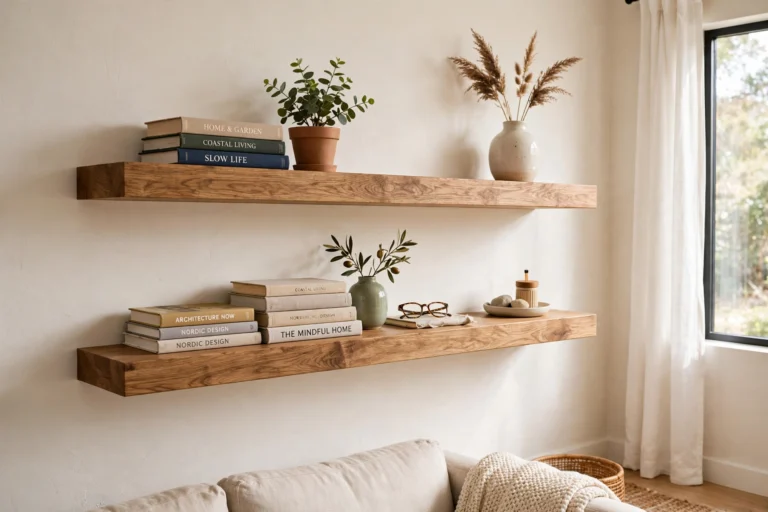
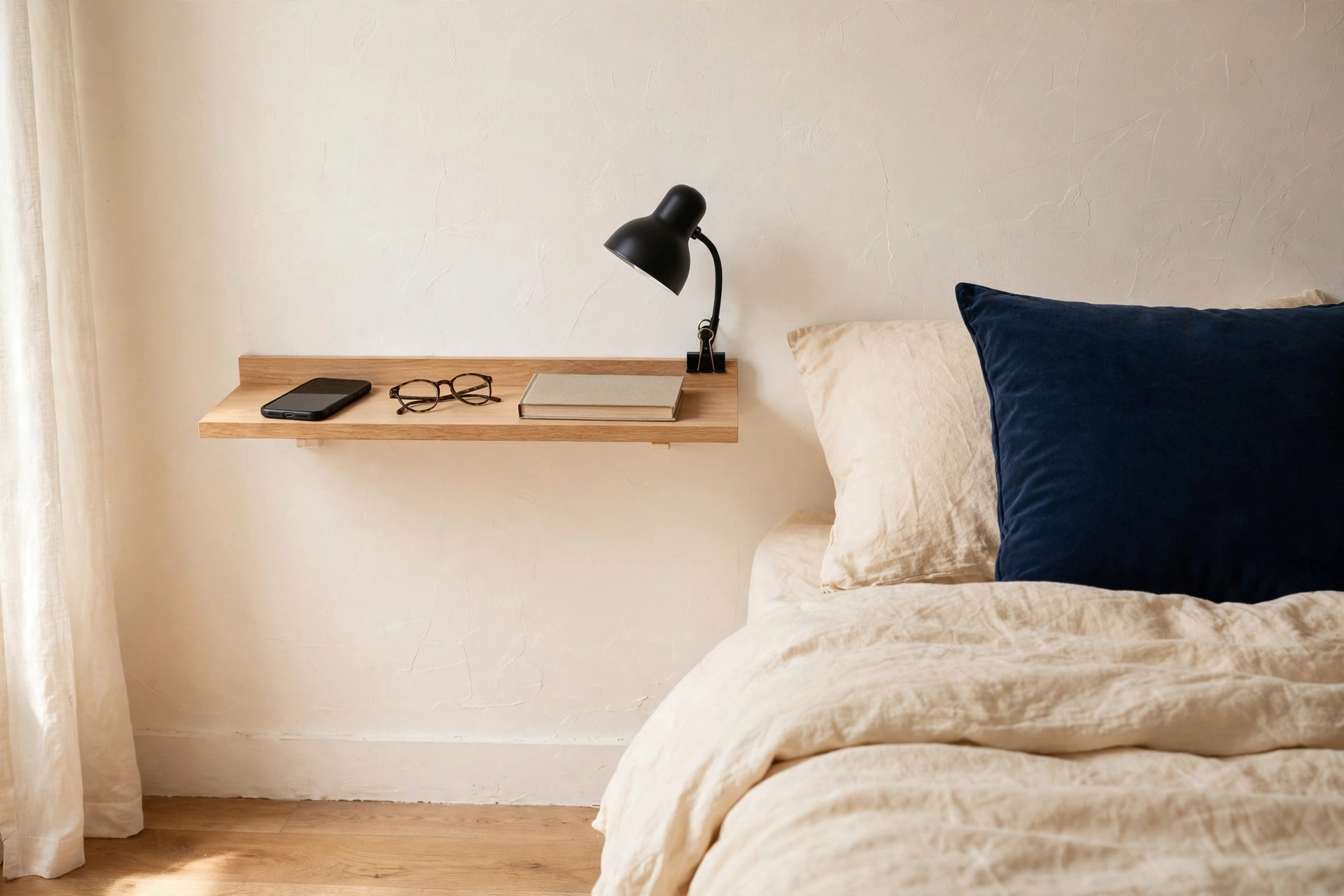
One shelf, fixed to the wall at mattress height, with a small lip or a second shelf below it for a book. This is the most underrated bedside in a small bedroom because it uses zero floor space, which is exactly what a tight gap needs. A 24-inch shelf, 6 inches deep, holds a phone, glasses, and a slim book. Add a clip-on light and you have a full nightstand that takes up no floor at all.
Best for: gaps under 12 inches, where nothing with legs fits. Main advantage: zero floor space, and the height is whatever you choose. Watch out for: it must go into a stud, or into proper wall anchors rated for the load. Adhesive strips alone will not hold a lamp. And the 30 lb rating above is a ceiling, not a target. Verdict: the smartest use of a tight gap, but only if it is screwed in properly. Renter-Friendliness: 2/5. Two screw holes to fill before move-out.
4. The thrift stool swap
A thrift-store stool, 10 to 12 inches across the seat, pulled up beside the bed. It sounds too simple to count, and that is the point. A stool is already the right height, usually 18 to 24 inches, and the round seat fits a 10-inch gap that defeats every rectangular table. Sand it, paint it, and it stops looking like a stool and starts looking like a choice. For more ideas on giving a small bedroom a finished look without buying new furniture, see our small bedroom organization ideas.
Best for: the cheapest possible fix, and for renters who cannot drill anything. Main advantage: $5 to $15, zero build time, and you can take it with you when you move. Watch out for: a round seat holds less than a square top, so a lamp plus a glass of water is already crowded. Keep it to phone, glasses, and one book. Verdict: the fastest way from no nightstand to a nightstand. Renter-Friendliness: 5/5.
5. The rolling cart
A slim three-tier rolling cart, about 15 inches wide, parked beside the bed. It is the only build on this list that moves. Roll it out when you need the floor, roll it back at night, and the three tiers hold more than any single-surface nightstand: lamp on top, books in the middle, chargers and clutter at the bottom. It suits a bedroom that changes jobs during the day, a desk by daylight and a bedroom at night.
Best for: bedrooms that double as workspaces, and anyone who rearranges often. Main advantage: three tiers of storage in a 15-inch footprint, and it rolls away. Watch out for: cheap carts wobble, so check the casters lock, and a top-heavy cart tips if the lamp goes on the top tier and nothing heavy sits below. Verdict: the most storage per inch of floor. Renter-Friendliness: 5/5.
6. The leaning ladder shelf
A narrow leaning ladder shelf, about 12 inches wide at the base, standing against the wall beside the bed. The bottom rung sits at mattress height and works as the nightstand surface, while the rungs above hold books, a plant, and a clock. It needs no fixing at all, just a wall to lean on, and it turns a dead strip of wall into vertical storage. If you are planning the whole room around a tight bed wall, our small bedroom layout ideas show how the bed, the shelf, and the walkway fit together.
Best for: tall, narrow gaps where floor space is tight but wall space is free. Main advantage: five surfaces in a 12-inch footprint, and it leans, so no holes. Watch out for: it needs a flat wall and a level floor, and anything on the top rungs is in dusting territory. Keep the nightly essentials on the bottom rung only. Verdict: the best vertical option. Renter-Friendliness: 5/5.
7. The clip-on bed shelf and bedside caddy
For gaps under 10 inches, where even a stool will not fit, stop looking for furniture and use the bed itself. A clip-on shelf clamps to the bed frame and holds a phone and glasses. A fabric bedside caddy hangs over the side of the mattress and holds a book, a charger, and a remote. Together they cost less than a takeaway dinner and solve the problem completely.
Best for: gaps under 10 inches, bunk beds, and beds pushed hard against the wall. Main advantage: zero floor, zero wall, and it moves with the bed. Watch out for: check the clamp fits your bed frame before you buy, and a caddy full of heavy books will sag the mattress edge over time. Keep it light. Verdict: the honest answer for the tightest gaps. Renter-Friendliness: 5/5.
8. The fold-down wall shelf
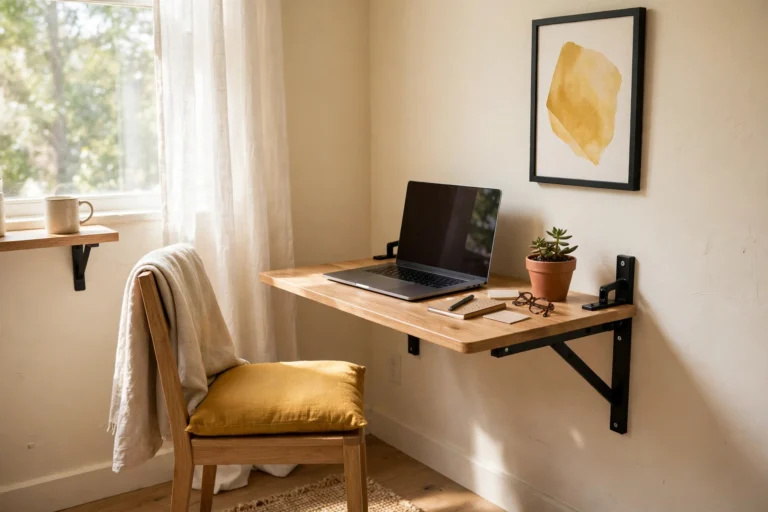
A small shelf on folding brackets that drops flat against the wall when you do not need it. Up, it is a nightstand. Down, it is a 2-inch strip on the wall and the walkway is fully clear. This is the build for a bedroom where the nightstand is only needed at night, for example a room where a desk chair or a laundry basket passes that spot during the day.
Best for: walkways that need to be clear during the day. Main advantage: a full nightstand surface that disappears. Watch out for: the brackets must be fixed into a stud, and the folding mechanism needs a firm push to lock, so test it empty before you put a lamp on it. Verdict: the cleverest build, but only for confident drillers. Renter-Friendliness: 2/5. Two screw holes per bracket to fill later.
How tall should a nightstand be?
The short answer is the top should sit within 2 inches (5 cm) of your mattress top, which for most beds means a nightstand between 22 and 28 inches (56 and 71 cm) tall. The longer answer is in the mattress-height table above: measure the mattress top from the floor, pick a target inside the range, and subtract the top thickness to get the leg length. A nightstand that is too tall is worse than one that is too low. Too low, and you reach down. Too tall, and you reach up in the dark and knock the lamp over. If you are buying legs, remember the standard sizes are 16, 18, 22, 24, and 28 inches. Pick the size at or below your computed length, then make up the difference with felt pads, never by stacking books under the legs.
What does a DIY nightstand cost?
Prices checked in November 2026. Ranges come from a DIY cost guide; the two exact prices are live listings read this week.
| Build | Main parts | Cost, as of November 2026 |
|---|---|---|
| Crate stack | 2 wooden crates | $10 to $25 |
| Hairpin-leg box | 4 hairpin legs, $24.99, plus 1×12 pine board, $14.00 | $38.99 |
| Floating shelf | Threshold 24 in shelf, hardware included | $40.00 |
| Thrift stool | Thrift-store stool | $5 to $15 |
| Ladder shelf | Scrap wood and screws | $15 to $40 |
The cheapest way in is the thrift stool at $5 to $15. The best-looking build is the hairpin-leg box at $38.99, legs plus board. The zero-floor option is the floating shelf at $40.00. One honest note: that shelf cost $21 at the same store a year ago and now lists at $40, so check the price on the day you buy, not the day you read this. Most builds take under two hours. The crate stack takes 15 minutes. The hairpin-leg box takes one to two hours including sanding and one coat of paint. The floating shelf takes 30 to 45 minutes, most of it finding the stud.
How to build a floating nightstand shelf, step by step
This is the one build on the list that needs a drill and a stud, so here it is in full. It is the floating shelf from idea 3, built from a board and hidden brackets rather than bought ready-made.
Materials: one pine board, 24 by 12 inches (61 by 30 cm), 3/4 inch thick; one hidden floating-shelf bracket kit rated for at least 30 lb; a stud finder; a level; a drill; screws from the bracket kit; a pencil; a tape measure; sandpaper; paint or clear finish.
- Measure the mattress top height and mark the shelf height on the wall, so the shelf top sits within 2 inches of the mattress.
- Find the stud with the stud finder and mark its center. Mark a second stud if the shelf spans two.
- Hold the bracket against the wall at the marked height and level it. Mark the screw holes through the bracket.
- Drill pilot holes into the stud at the marks, then drive the bracket screws in until the bracket sits tight and level.
- Sand the board smooth, wipe off the dust, and paint or finish it. Let it dry fully.
- Slide the board onto the bracket rods until it sits flush against the wall, then tighten the set screws underneath.
- Load-test it before you trust it. Put books on it adding up to about 10 lb, leave it overnight, and check in the morning that nothing has moved. Only then put the lamp on it.
If the stud is not where you need it, stop and move the shelf, do not improvise with adhesive. A floating shelf that falls takes the lamp, the phone, and the wall paint with it.
Mistakes to avoid
Building before measuring. The gap decides the build. Measure the gap, the mattress height, and the walkway before you buy anything.
A nightstand taller than the mattress plus 2 inches. You will knock the lamp over reaching up in the dark. Stay inside the 2-inch rule.
A nightstand deeper than 16 inches. Depth is what eats the walkway, not width. Keep the depth at 12 to 16 inches and the room keeps its path.
An adhesive-only floating shelf with a lamp on it. Adhesive holds a phone. It does not hold a lamp plus a book plus a phone. Screw it into a stud or do not build it.
Forgetting the charger. Every build needs a cable route. A small hole or a clip on the back of the box beats a cable draped across the walkway.
Buying the matching set. This is the most overrated buy for a small bedroom. Two wide matching nightstands eat the walkway and lock the layout. One good build on your side is better than a matched pair that does not fit.
What to skip
Skip nightstands deeper than 16 inches, nightstands wider than 20 inches, and matching bedroom sets in a small room. Skip glass-top nightstands, which show every fingerprint and chip at the corners. Skip adhesive-only floating shelves for anything heavier than a phone. And skip the full-size bedside table with three drawers. In a small bedroom, a drawer you cannot open because the bed is in the way is not storage, it is a wall.
A note for renters
Check your lease before you drill anything. Six of the eight builds above need no drilling at all: the crate stack, the hairpin-leg box, the thrift stool, the rolling cart, the ladder shelf, and the clip-on shelf all stand on the floor or the bed. The two that drill, the floating shelf and the fold-down shelf, each leave two small screw holes per bracket. Those are easy to fill with filler and touch up with paint before move-out, and they are the kind of small hole most leases treat as normal wear. But “most leases” is not your lease. Read the decorating clause first, ask the landlord in writing if you are unsure, and keep the original hardware so you can reverse the whole thing in an afternoon. If the answer is no drilling at all, build the hairpin-leg box. It looks the most like real furniture and leaves no trace at all.
Sources
Prices in the cost table were checked in November 2026: the Threshold 24-inch floating shelf at $40.00 on Target, and the 16-inch hairpin leg set of 4 at $24.99 on Amazon. Size rules (22 to 28 inch height, 12 to 18 inch width, 12 to 16 inch depth, 24 inch walkway) are the consensus across the small DIY blogs that rank for this query. Weight ratings are the makers’ stated figures quoted in those guides. How this was made: the size tables were computed from those published rules, and every price was checked against a live listing or a published cost guide in November 2026. No product was tested by us and no hands-on claim is made.
Frequently asked questions
What can I use instead of a nightstand?
A stool, a crate stack, a floating shelf, a rolling cart, or a clip-on bed shelf all work. Pick by the gap: under 10 inches, use the wall or the bed itself; 10 to 12 inches, a stool or a slim shelf; 12 to 16 inches, a crate stack or a hairpin-leg box.
How tall should a nightstand be?
The top should sit within 2 inches (5 cm) of your mattress top, which for most beds means 22 to 28 inches (56 to 71 cm) tall. Measure the mattress top from the floor, then subtract the thickness of the shelf or box top to get the leg length.
How wide should a nightstand be in a small bedroom?
Between 12 and 18 inches (30 and 46 cm) wide, and no deeper than 16 inches (41 cm). Under 12 inches, use a floating shelf or a clip-on shelf instead of a table. Over 20 inches wide, and the nightstand starts eating the 24-inch walkway the room needs.
Can you have a nightstand in a rental without drilling?
Yes. Six of the eight builds in this post need no drilling: the crate stack, the hairpin-leg box, the thrift stool, the rolling cart, the ladder shelf, and the clip-on shelf. Only the floating shelf and the fold-down shelf need screws, and those leave two small holes per bracket to fill before move-out.