Small Coat Closet Organization Ideas: 10 Fixes That End the Doorway Pile-Up
Small coat closet organization ideas work best when you start with a number, not a bin. A coat needs about 4 inches (10 cm) of rod, and one adult needs about 4 feet (122 cm) of rod to live comfortably, so a standard 36 inch (91 cm) closet holds about 9 coats at most. Count your rod, set a coat budget per person, and everything else falls into place. The hangers, the shoe plan, and the seasonal swap all follow from that one count. These 10 ideas fit a tiny closet, cost about $50 in total, and take one afternoon.
How many coats does your small coat closet actually hold?
This is the question every other guide skips, and it is the whole game. Two published figures settle it. A coat needs about 4 inches (10 cm) of rod space. One adult needs about 4 feet (122 cm) of rod to keep a working wardrobe in reach. Divide your rod length by 4 inches and you have your closet’s hard limit. No bin, hook, or hanger beats that arithmetic.
| Closet rod width | Max coats (at 4 in each) | 1 person | 2 people | 3 people | 4 people |
|---|---|---|---|---|---|
| 24 in (61 cm) | 6 | 6 each | 3 each | 2 each | Not enough rod |
| 30 in (76 cm) | 7 | 7 each | 3 each | 2 each | 1 each, plus overflow |
| 36 in (91 cm) | 9 | 9 each | 4 each | 3 each | 2 each |
| 48 in (122 cm) | 12 | 12 each | 6 each | 4 each | 3 each |
Read the table honestly. Two people sharing a 36 inch closet get 4 coats each, plus one spare. That is the budget. The rest of the coats live in a bedroom closet or under-bed storage, not crammed onto this rod. If your household has four people and a 24 inch closet, the closet cannot hold everyone. One person’s coats rotate out by season, and the entryway hooks take the daily drivers. That is not failure. That is the math working. Small coat closet organization ideas start here, because the number decides everything else.
Best for: every household, before spending a dollar. Main advantage: it ends the argument about whose coats stay. Watch out for: puffy winter parkas eat more than 4 inches each, so count a parka as 6 inches (15 cm) in winter. Verdict: do this first, or skip the rest. Deposit risk: 1/5. Counting costs nothing.
What does a small coat closet organization project cost?
Prices checked live in November 2026 from Target listings and a published doubler-rod guide. No invented prices, no personal receipts, just what the stores list.
| Item | Price (as of November 2026) |
|---|---|
| Hook-on closet doubler rod (no drilling) | $15.00 to $25.00 (use $20.00) |
| Brightroom 30-pack flocked hangers | $12.00 |
| Brightroom 2-pack adjustable shelf dividers | $10.00 |
| Brightroom 9-pocket over-the-door organizer | $8.00 |
| Total | $50.00 |
Time estimate: 2 to 4 hours for an average closet, including the purge. A small one-person closet takes closer to 2 hours. A busy family closet takes the full 4. Buy nothing until the purge is done, because the purge usually cuts the shopping list in half.
Materials list
- Tape measure
- 4 sorting piles (bags or boxes): keep here, keep elsewhere, donate, toss
- Hook-on closet doubler rod
- Slim velvet hangers (30-pack)
- 2 shelf dividers
- Over-the-door organizer
- Boot tray and one small labeled bin per person
- Labels or painter’s tape and a marker
1. Purge what does not belong in a coat closet
Pull everything out first. Every guide says this, and every guide is right, because you cannot count a rod you cannot see. Sort into four piles: keep in this closet, keep elsewhere, donate, toss. Be blunt about the “does not belong” list. Outgrown kids’ coats, single gloves, broken umbrellas, reusable shopping bags by the dozen, the beach umbrella, the mystery box of scarves. A coat closet is for what you wear this week, plus one backup. Everything else is storage pretending to be organization.
Best for: closets that have not been emptied in a year or more. Main advantage: it is free, and it usually frees a third of the rod. Watch out for: the “maybe” pile. If a coat has not been worn in two winters, it is a donate, not a maybe. Verdict: the highest-return hour in this whole project. Deposit risk: 1/5.
2. Hang by person, daily coats first
Give each person their own section of the rod, in the order they leave the house. The earliest riser gets the spot nearest the door. Daily coats hang at grab height, front and center. Dress coats, formal coats, and the backup puffer move to one end. Color-coded hangers or a small tag on the rod helps kids find their spot without asking. Our general closet organization guide covers double-hang rod heights in detail, so check that before you mount anything permanent.
Best for: families of two or more. Main advantage: mornings stop being a shuffle. Watch out for: one person’s section creeping into the next. The rod budget from the table above is the referee. Verdict: simple, and it sticks because it matches how people actually leave the house. Deposit risk: 1/5.
3. Switch to slim hangers, but keep wide ones for heavy coats
Slim velvet hangers are about 0.2 inches (0.5 cm) thick, against roughly 0.5 inches (1.3 cm) for a bulky plastic hanger. Swap a full rod and you recover up to half the rod space, which is often 2 or 3 extra coats. But here is the part the listicles skip. Heavy wool coats and parkas need wide, sturdy hangers, or the shoulders sag and the coat loses its shape. Use slim hangers for light jackets and rain shells. Keep wide hangers for the two or three heavy coats that matter.
Best for: closets where the rod is full but the coats are light. Main advantage: the cheapest space you will ever buy, about $12 for 30 hangers. Watch out for: cheap velvet hangers snapping under a wet wool coat. If it feels flimsy, it is. Verdict: do it, but do not hang your best coat on your worst hanger. Deposit risk: 1/5.
4. Add a hook-on doubler rod for short jackets only
A hook-on doubler rod hangs from your existing rod and adds a second rod below it, no drilling and no screws, for about $15 to $25. Short jackets, kids’ coats, and bags hung by their handles fit on the lower rod. This is the single highest-impact hardware buy in this project. The trap is doubling the whole closet. Long coats need 12 to 24 inches (30 to 61 cm) of single rod, or they bunch on the floor. Double one section for short items. Leave the long-coat section alone.
Best for: renters and anyone who cannot drill. Main advantage: doubles hanging space in one section in about 2 minutes. Watch out for: weight. Most hook-on rods hold 20 to 25 pounds (9 to 11 kg), and all of it pulls on your old rod. Keep the lower rod light. Verdict: the best $20 in this project, used on half the closet only. Deposit risk: 1/5. It hooks on and lifts off.
5. Build the shoe and boot floor plan with real measurements
A standard reach-in coat closet is 24 inches (61 cm) deep. That depth decides the whole floor plan, so measure before you buy a rack. A slim two-tier shoe rack about 10 inches (25 cm) deep leaves room to step in. A boot tray about 14 inches (36 cm) deep holds two pairs of tall boots. In a 36 inch (91 cm) wide closet, the honest layout is a shoe rack on one side and a boot tray on the other, with the middle kept clear for long coats to hang. Two pairs of shoes per person is the working limit, the same 2-3 coats rule applied to feet.
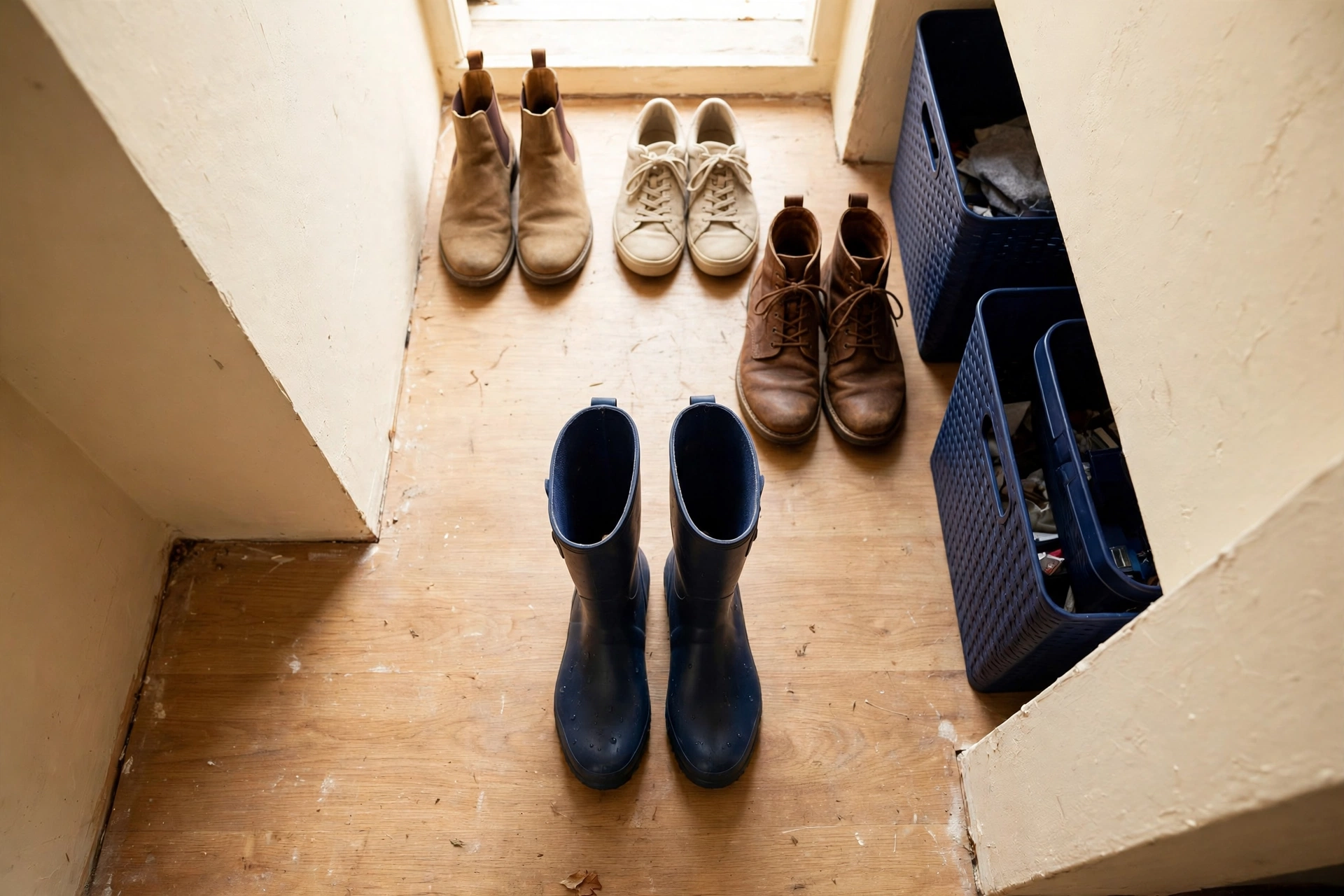
Best for: households where shoes breed on the closet floor. Main advantage: every pair has a marked home, so the pile stops growing. Watch out for: racks deeper than 12 inches (30 cm) in a 24 inch closet. They block the door swing and eat the coat hem space. Verdict: measure the depth first, buy the rack second. Deposit risk: 1/5.
6. Give wet gear its own corner
Wet boots, dripping umbrellas, and damp rain shells are what turn an organized closet into a musty one. Put a rubber boot tray in one floor corner and stand umbrellas in it, handles up. Hang the wet rain shell on the hook nearest the door, not buried in the middle of the rod, so air reaches it. If the closet has no ventilation, leave the door open for an hour after a rainy walk. Our renter friendly bathroom storage guide uses the same dry-first rule for damp spaces, and it applies here too.
Best for: rainy climates and homes with kids or dogs. Main advantage: it stops mildew before it starts, and it keeps the floor dry. Watch out for: storing wet boots on carpet or bare wood. The tray is not optional, it is the whole point. Verdict: a $10 habit that saves a $200 problem. Deposit risk: 1/5.
7. Zone the top shelf with dividers
The top shelf is where off-season and rarely used things live, but only if it is divided. Without dividers, folded scarves lean, hats slide, and one stack becomes a landslide. Two shelf dividers split the shelf into three zones: left for hats and gloves in a bin, middle for folded scarves, right for the off-season accessories. Label each zone. The top shelf is also the right home for the vacuum storage bags holding out-of-season coats, kept loose so puffy insulation is not crushed flat for months.
Best for: closets with a single high shelf and no built-ins. Main advantage: the shelf stops being a junk ledge. Watch out for: heavy bins on a high shelf in a rental. Keep it light, or the shelf sags and the deposit suffers. Verdict: small money, big calm. Deposit risk: 1/5.
8. Use the door, but respect the clearance
The inside of the closet door is free storage, if the organizer is slim enough for the door to close. A 9-pocket over-the-door organizer holds gloves, hats, dog leashes, and reusable bags in plain sight. Measure first. The organizer plus its hooks must stay under about 2 inches (5 cm) deep, or the door will not latch and the frame takes the damage. If the door is a sliding door, skip the over-door organizer entirely and use side-wall hooks instead. The stackable storage bins we compared work well on the top shelf too, but keep them narrow and deep, not wide and shallow.
Best for: narrow closets with no side-wall space. Main advantage: small items stop vanishing into the dark corners. Watch out for: deep organizers on bifold doors. They jam the fold and scuff the frame. Verdict: measure the depth, then buy. Deposit risk: 1/5 for a hook-over organizer, 3/5 if you screw hooks into the door.
9. Run a seasonal rotation with real dates
Rotation is the system that keeps the budget working all year. Twice a year, on a date you can remember, swap the closet. In late October, the heavy coats come in and the light jackets move to the top shelf or the bedroom closet. In late April, the swap reverses. Two labeled bins on the top shelf hold the off-season set, one per season, so the swap takes 20 minutes instead of an afternoon. The rule is simple. If a coat will not be worn for the next 4 weeks, it does not live on the rod.
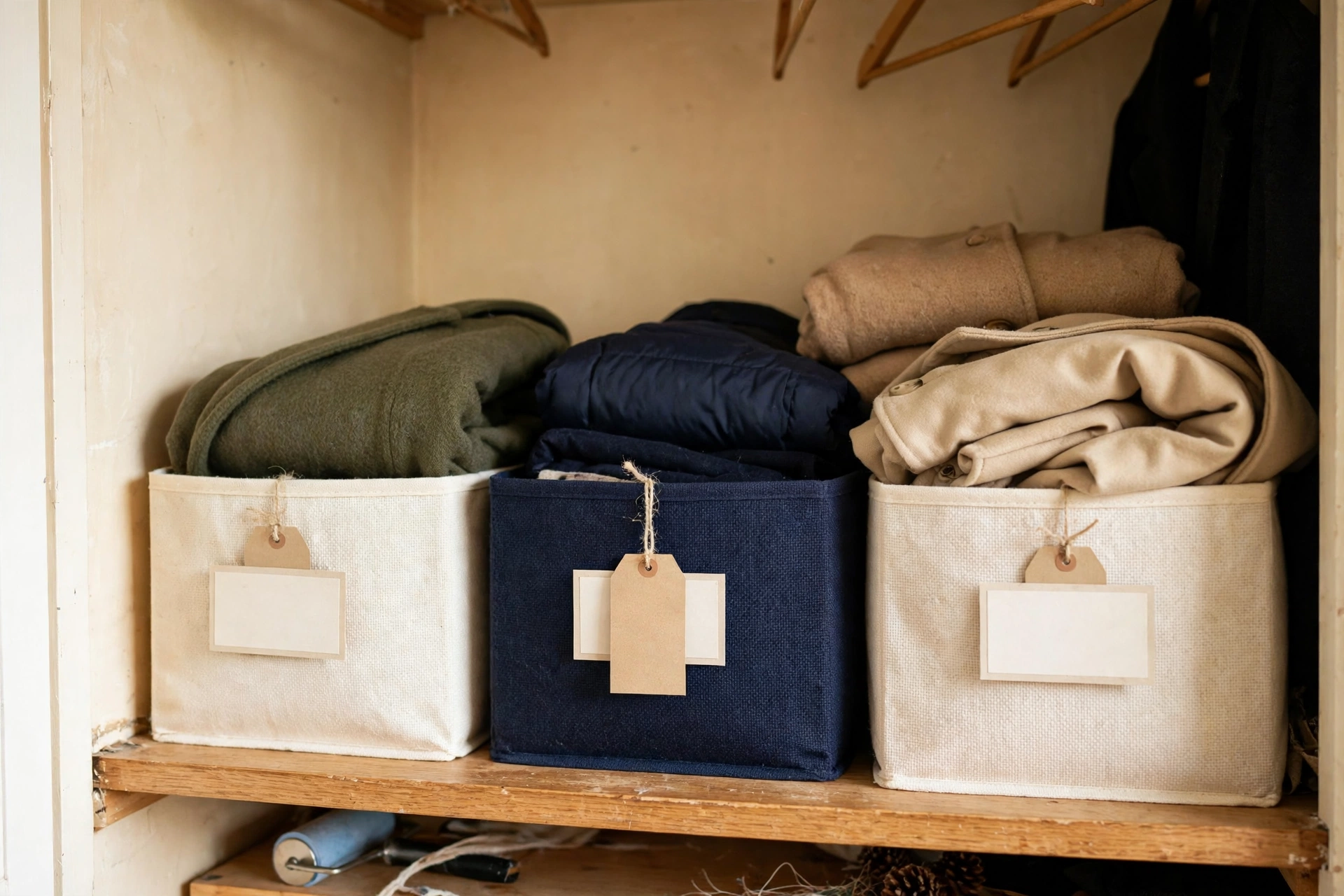
Best for: homes with four real seasons. Main advantage: the closet always holds the current season only, so the rod budget never breaks. Watch out for: skipping the spring swap. Summer coats left in the closet eat the rod all winter. Verdict: the difference between organized once and organized for good. Deposit risk: 1/5.
10. Put the drop zone outside the closet
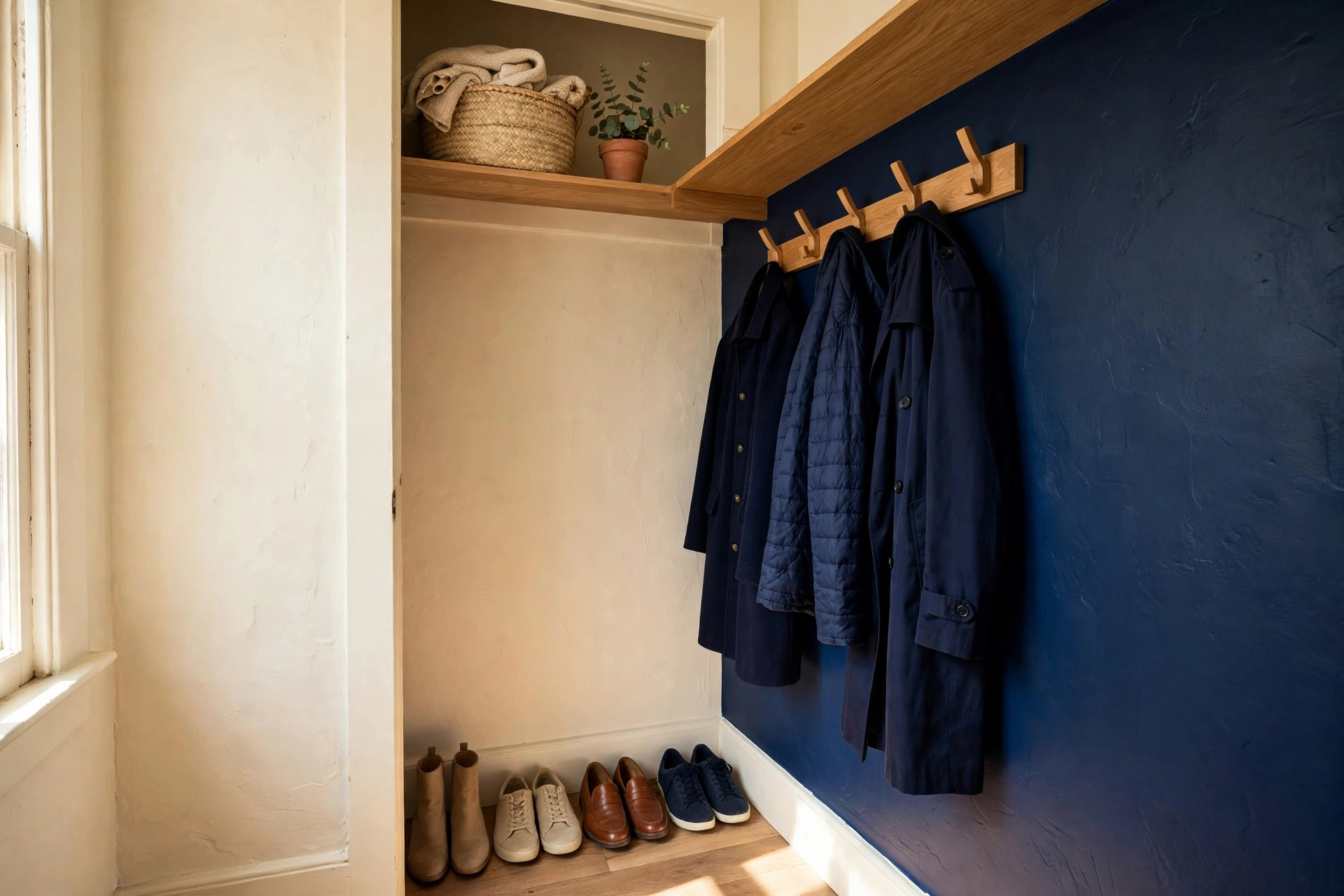
A tiny coat closet cannot hold bags, keys, mail, and school backpacks too. That is what the wall beside it is for. Three hooks at adult height, one low hook for kids, and a small basket underneath for keys and mail turn the 2 feet (61 cm) beside the closet into a drop zone. Our tiny entryway setup shows how this works in a full hallway, and the same logic fits a single wall. Keep one bag per person on a hook. The rest of the bags live elsewhere, or the drop zone becomes a second closet.
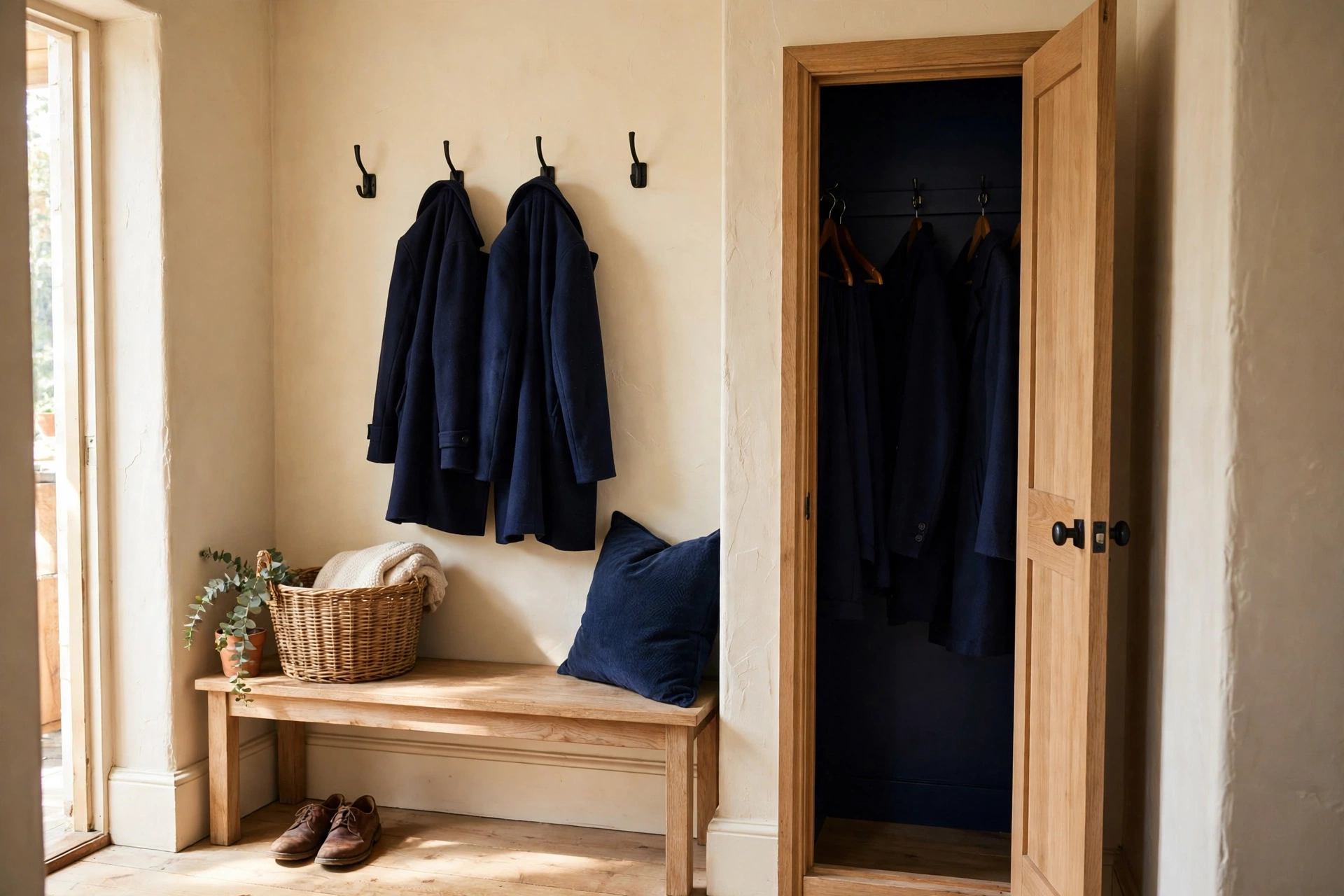
Best for: homes where the closet is too small for the whole household. Main advantage: it doubles the entryway’s capacity without touching the closet. Watch out for: hooks screwed into drywall with no anchor. A loaded backpack pulls a bare screw straight out. Use adhesive hooks for light items, or a stud for anything heavy. Verdict: the closet holds coats, the wall holds the day. Deposit risk: 2/5 with adhesive hooks, 3/5 with screwed hooks.
Small coat closet organization ideas: 7 steps in order
These small coat closet organization ideas work best in order. Each step takes 15 to 30 minutes, and the whole job fits in one afternoon.
Step 1: Empty the closet completely. Take everything out, including the top shelf and the floor. Vacuum the floor and wipe the shelf.
Step 2: Sort into four piles. Keep here, keep elsewhere, donate, toss. Count the coats as you sort.
Step 3: Measure the rod and the floor. Rod length in inches, floor width and depth in inches. Write the numbers down.
Step 4: Set the coat budget. Divide rod inches by 4. That is your max coat count. Split it per person using the table above.
Step 5: Hang by person, daily coats first. Slim hangers for light jackets, wide hangers for heavy coats. Daily drivers nearest the door.
Step 6: Build the floor plan. Shoe rack on one side, boot tray on the other, middle clear for long coats. Over-door organizer on last.
Step 7: Set the rotation date. Write the next swap date on the top-shelf label. Late October and late April are good defaults.
Mistakes to avoid
Buying bins before counting the rod. Bins hide the problem. The rod count is the problem, and no bin fixes a closet holding 14 coats on a 9-coat rod.
Doubling the whole rod. Long coats need their single-rod section. Double the short-jacket section only, or every long coat ends up bunched on the floor.
Storing wet gear on the floor. Boots without a tray soak the floor and grow mildew. The tray costs less than the repair.
Forgetting the door swing. A shoe rack that blocks the door, or an organizer too deep to latch, turns a fix into daily annoyance.
Skipping the rotation date. Without a date on the label, the off-season coats stay on the rod forever, and the budget quietly breaks.
What to skip
Matching bin sets. A matching set looks good in a photo and fits nothing in a real closet. Buy narrow, deep bins with handles, one at a time, sized to your shelf.
Bulky wooden hangers for every coat. One or two for heavy coats, yes. A full rod of them eats the space you just bought with slim hangers.
A second closet system install. In a rental, a fitted system costs hundreds and risks the deposit. The hook-on rod, dividers, and over-door organizer do the same job for about $50 and leave no holes.
Vacuum bags for wool coats. Puffy synthetic coats can be stored loosely in bags, but vacuum-sealing wool crushes the fibers. Fold wool coats flat in a bin instead.
A note for renters
Check your lease before you mount anything. Most leases allow hook-on rods, over-door organizers, and freestanding racks without permission, because they leave no marks. Screwed-in hooks, a removed closet door, and wall-mounted rails usually need written permission, and a door stored in a garage can be a deposit deduction if it is scratched. Photograph the closet before you start, keep the original rod and shelf exactly as they were, and everything in this guide except the screwed hooks comes off cleanly in under an hour when you move out.
Small coat closet organization ideas come down to three things: a counted rod, a measured floor plan, and a date on the label. Get those three right and the closet stays organized long after the afternoon you spent on it.

How do you organize a small coat closet?
Declutter first, then go vertical. Use the door with an over-the-door organizer, add hooks on the side walls, put a slim shoe rack on the floor, and keep off-season items on the top shelf or in another room. Count the rod before buying anything, because a coat needs about 4 inches of rod and that count decides how many coats can stay.
How many coats should each person keep in the coat closet?
Two to three coats per person is a good guideline for the coat closet, plus two pairs of shoes and one bag. Store the rest elsewhere. On a standard 36 inch rod, two people get 4 coats each at most, so the number comes from the rod length, not from wishful thinking.
How can I organize a small coat closet for winter?
Keep everyday coats, current boots, hats, gloves, and bags near the door. Use hooks, baskets, and a shoe tray to give frequently used items a consistent place. Put the heavy parka at grab height, the rain shell on the door hook to dry, and the light jackets up on the top shelf until spring.
How many coats should I keep in my entryway?
Only the coats you are actively wearing that week. A good rule of thumb is 2 to 3 coats per person. Other coats should be stored in a bedroom closet or other storage area to keep the entryway clear and functional.
The rod math in this post comes from published figures: Nest Sorted’s coat closet guide, which gives the 2 to 3 coats per person guideline and the 12 to 24 inch single-rod rule for long coats, and Urbin Storage’s small closet guide, which gives the 4 inches of rod per coat and 4 feet of rod per person figures. Prices are from Target listings and a published doubler-rod guide, checked in November 2026.