Renter-Friendly Bathroom Storage: 10 No-Drill Ideas When You Have No Counter Space
A bathroom with no counter space is not a storage problem. It is a placement problem. The toothbrush, the skincare, the hair tools and the towels all need a home, and the sink ledge is about 4 inches (10 cm) wide, so the towels usually live in the linen closet, and our small linen closet organization ideas show how to fit them in a tiny one. Renter friendly bathroom storage solves it without a drill, without glue that scars the tile, and without a single hole your landlord can charge you for. Below are 10 ideas that work in real rental bathrooms, compared by cost, by the weight they honestly hold, and by how safe your deposit is.
How much renter friendly bathroom storage can you add without drilling?
More than you think. A small bathroom has six zones most people never use: the shower corner, the wall above the toilet, the back of the door, the gap beside the toilet or vanity, the inside of the cabinet, and the strip of wall beside the mirror. Put one storage piece in each zone and the counter clears itself. Before you buy anything, measure five things. First, the under-sink space: width, depth and height around the pipes. Second, the door swing: how much clear space sits behind the door when it opens and closes. Third, any floor gap beside the toilet or vanity, and the walkway left over once something fills it. Fourth, the ceiling height in the shower corner. Fifth, the wall surface: smooth glazed tile holds adhesive, textured tile and old paint do not. Five minutes with a tape measure saves a return trip and a fallen shelf at 3 a.m.
10 renter friendly bathroom storage ideas compared
| Idea | Cost as of Nov 2026 | Honest load limit | Floor space used | Deposit risk (1-5, 5 safest) |
|---|---|---|---|---|
| Tension pole shower caddy | $29.98-$55.99 | Up to 20 lb (9 kg) per shelf | None (corner) | 5 |
| Over-toilet freestanding etagere | $29.99-$59.99 | Light items up top, under 5 lb | About 2 sq ft | 5 |
| Over-the-door organizer | $11.49-$22.99 | Pockets: toiletries and rolled towels | None | 5 |
| Slim rolling cart | $22 | Light daily items | About 1 sq ft | 5 |
| Command Bath hooks and shelves | $6.49-$13.44 | Large hook 2.2 kg; small strips 450 g | None | 4 |
| Under-sink bins and pullout | $5-$45 per organizer | Depends on the bin | None (inside cabinet) | 5 |
| Suction-cup shower caddy | Under $15 | Light bottles only | None | 4 |
| Tension rod under the sink | About $10 | Spray bottles by their triggers | None | 5 |
| Portable caddy kept outside | $0-$15 | Whatever fits in the tote | None | 5 |
| Narrow ladder shelf in a corner | $30-$60 typical | Towels and baskets, low and light | About 1.5 sq ft | 5 |
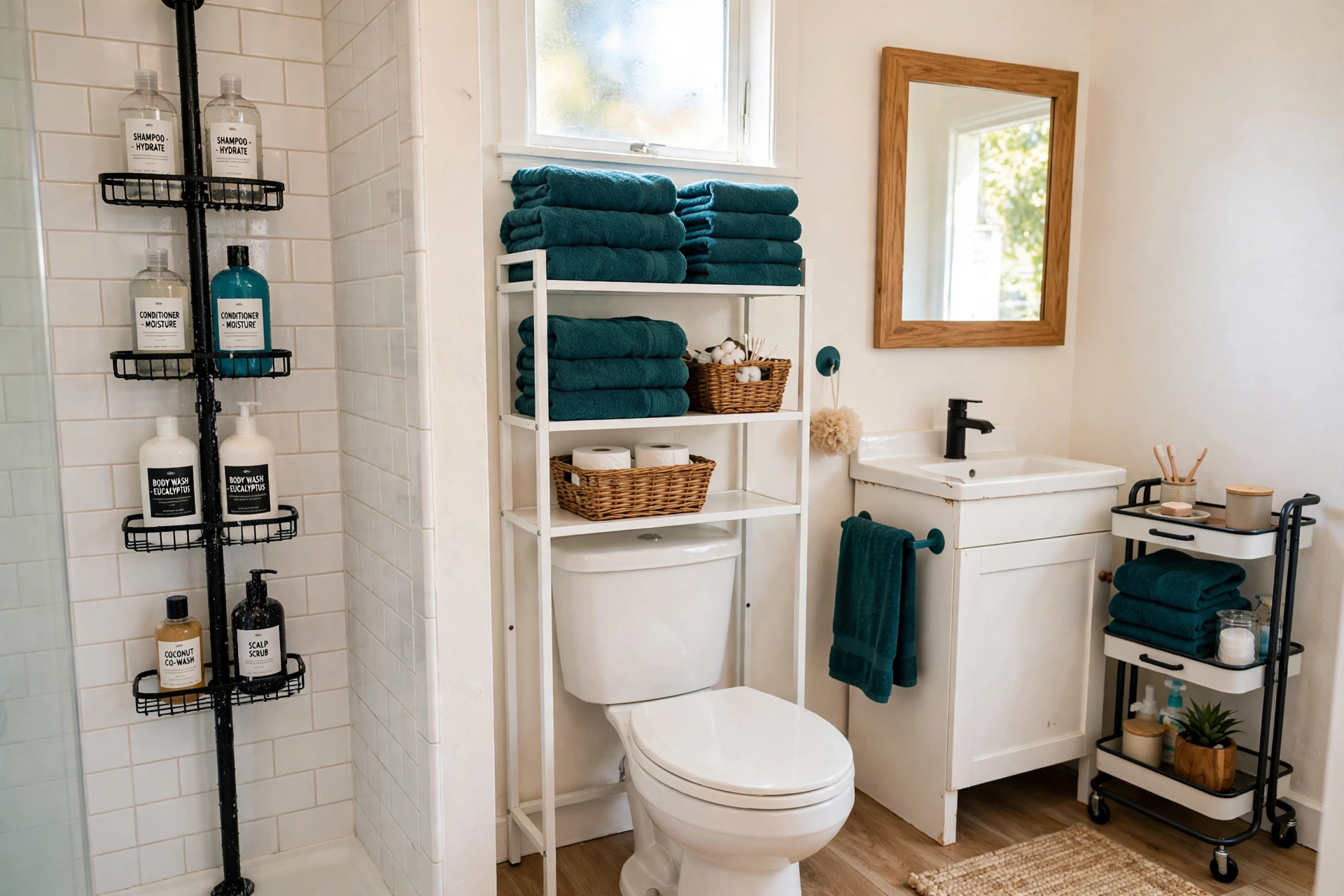
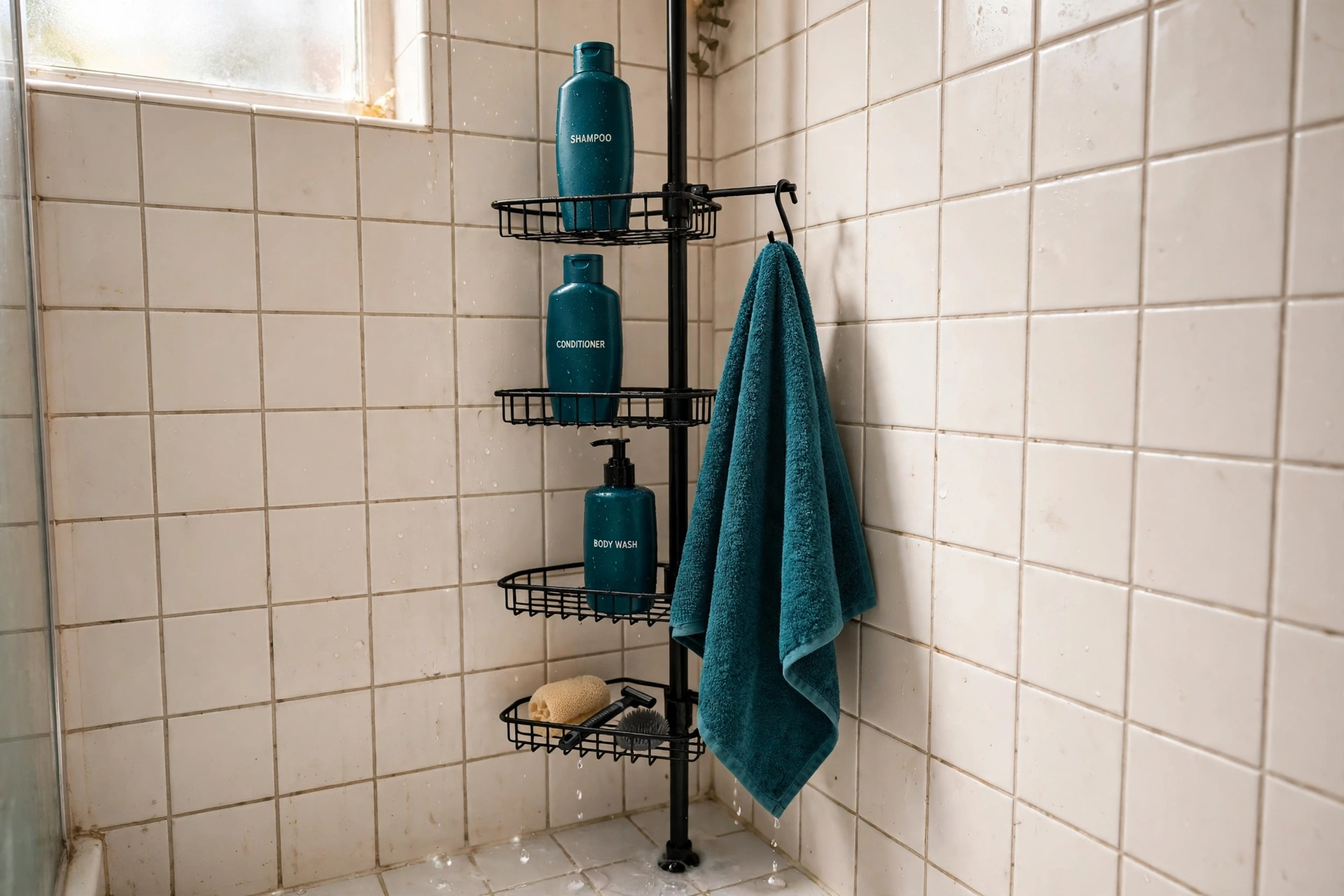
1. Tension pole shower caddy. Best for: every bottle that lives on the tub edge right now. Main advantage: a spring-loaded pole runs floor to ceiling and holds four real shelves without touching the wall. Watch out for: sloped or textured ceilings, where the pole cannot grip, and top shelves loaded with full litre bottles. Verdict: the single best first buy. It takes the wettest, heaviest stuff out of the way in ten minutes. Renter-friendliness: 5/5.
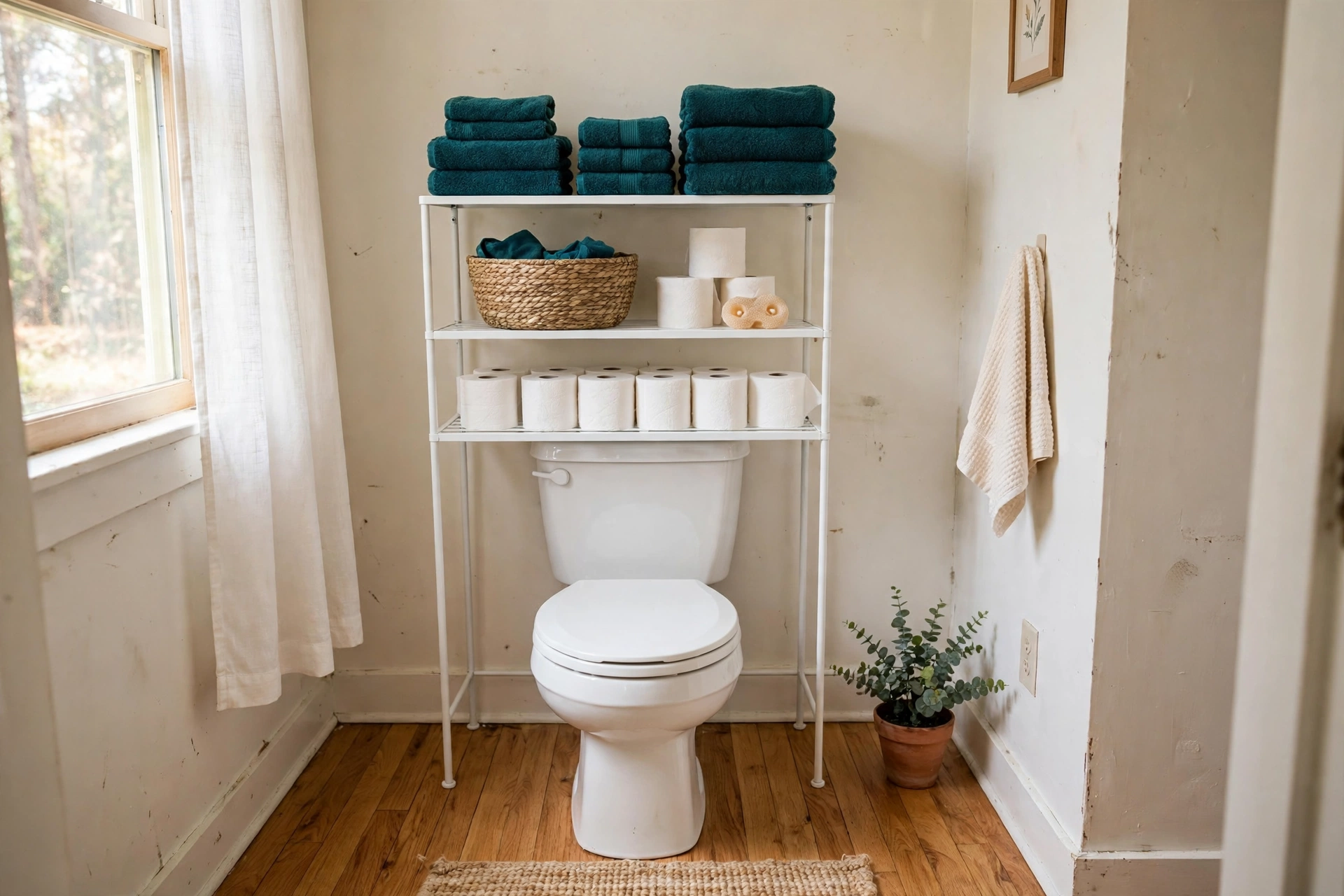
2. Over-toilet freestanding etagere. Best for: towels, spare toilet paper and the backup bottles. Main advantage: it stands on the floor behind the toilet and turns dead wall space into three shelves. Watch out for: measure first. Leave 8 to 12 inches (20 to 30 cm) clear above the tank so the lid lifts, and at least 1 inch (2.5 cm) between each leg and the tank sides. Verdict: the biggest storage gain per dollar in the whole list. Renter-friendliness: 5/5.
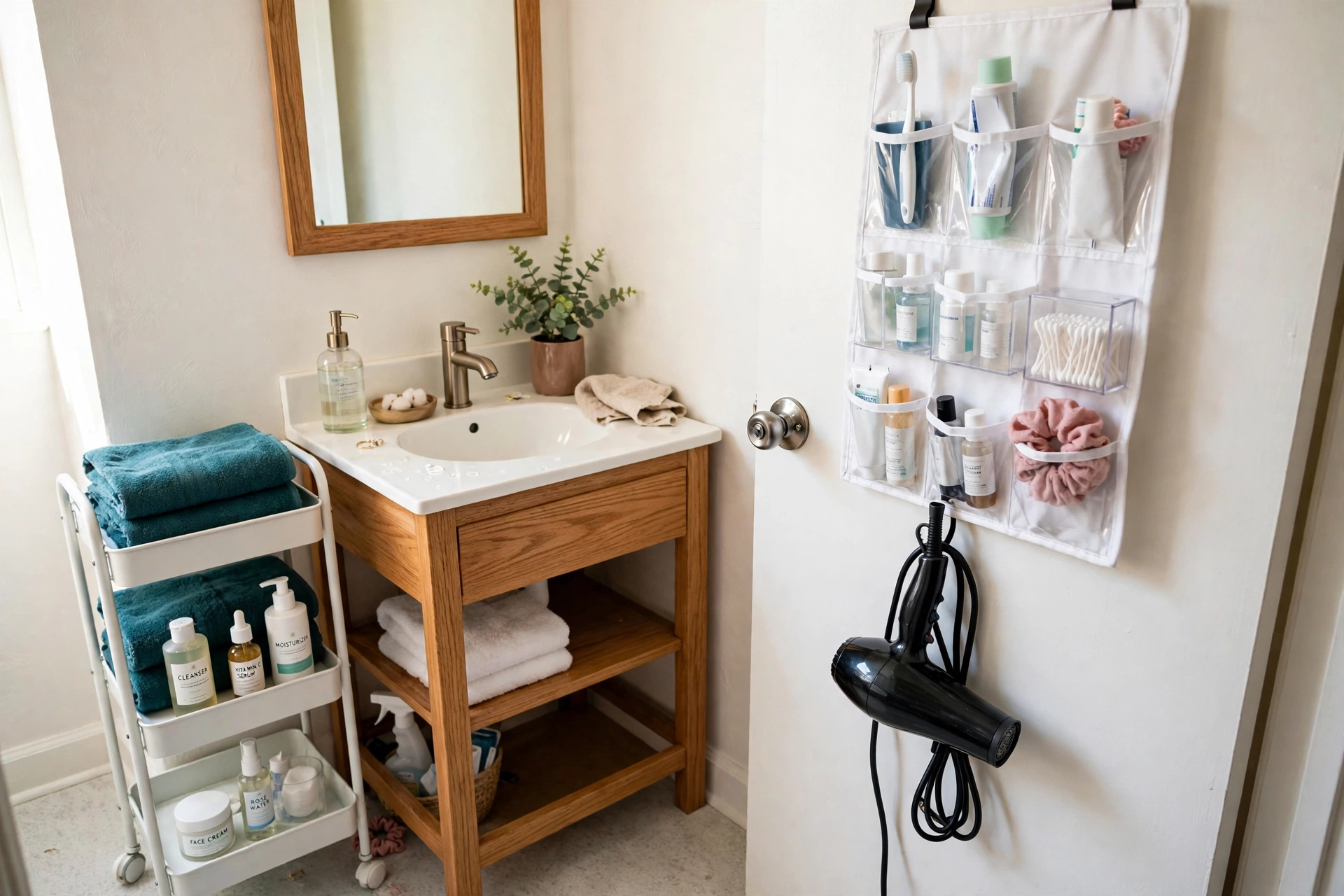
3. Over-the-door organizer. Best for: daily toiletries, hair tools and cleaning supplies. Main advantage: it uses a blank door instead of a wall or a floor, and the clear pockets mean you can see everything at a glance. Watch out for: over-door hooks need about 1/8 inch (3 mm) of clearance along the top edge of the door, so check before you order. Verdict: the best first $15 a renter can spend. Renter-friendliness: 5/5.
4. Slim rolling cart. Best for: the gap beside the toilet or vanity that is currently home to dust. Main advantage: it rolls out when you need it and rolls away when you clean. Watch out for: anything under 5 inches (13 cm) wide is too tight for a cart, and a cart that pinches the walkway will annoy you every single day. Verdict: brilliant if your gap measures 5 inches or more, useless if it does not. Measure first. Renter-friendliness: 5/5.
5. Command Bath hooks and shelves, the blue-strip kind only. Best for: robes, towels and the daily skincare you reach for half asleep. Main advantage: 3M’s water-resistant Bath range is made for humid rooms, and the strips pull off cleanly by the tab. Watch out for: this is the one idea people get wrong. Standard Command strips are not made for bathrooms. 3M’s own FAQ says the adhesive can soften above 40C (104F) and tells you to use the water-resistant line, the blue strips, in humid rooms like the bathroom. A large Bath hook holds 2.2 kg (about 4.9 lb). Small bath strips hold 450 g (about 1 lb) at most. Clean the tile with isopropyl alcohol first, press for 30 seconds, and wait a full hour before you hang anything. Verdict: excellent for light things on smooth tile, a bad idea for anything heavy or anything stuck to old paint. Renter-friendliness: 4/5.
6. Under-sink bins and a pullout caddy. Best for: backups, cleaning supplies and everything you use weekly rather than daily. Main advantage: stackable bins use the height of the cabinet, and a small turntable stops tall bottles getting lost at the back. Watch out for: the pipes split the cabinet in two, so measure the clear opening with the doors open, hinges included, before you buy. Our under-sink storage ideas walk through the pipe puzzle in detail, including the U-shaped organizers made to fit around a drain. Verdict: the least visible storage in the room, and the most of it. Renter-friendliness: 5/5.
7. Suction-cup shower caddy. Best for: two or three bottles in a shower with smooth, flat tile. Main advantage: it goes up in seconds and comes down without a mark. Watch out for: suction is overrated. It fails on textured tile, on grout lines, and the moment steam gets behind the cup. Keep it light and keep it low, so a fall lands on the tub floor and not on your foot. Verdict: a fine extra, a bad main plan. Renter-friendliness: 4/5.
8. Tension rod under the sink. Best for: spray bottles, which are the hardest thing to store under a sink. Main advantage: a cheap rod across the top of the cabinet lets you hang sprays by their triggers and leaves the cabinet floor free for bins. Watch out for: it only works if the cabinet sides are solid enough to hold tension, and heavy bottles will slide it down. Verdict: a $10 trick that feels like a renovation. Renter-friendliness: 5/5.
9. Portable caddy kept outside the bathroom. Best for: tiny bathrooms where even the door has no room. Main advantage: a tote or basket lives in the bedroom or hallway and comes in for your morning routine, then leaves. Watch out for: it only works if you actually put it back. One lazy week and the bathroom is a bottle yard again. Verdict: the honest answer for the smallest bathrooms, and it costs nothing if you already own a basket. Renter-friendliness: 5/5.
10. Narrow ladder shelf in a corner. Best for: rolled towels, baskets and a plant, if your bathroom has a spare corner. Main advantage: it leans, it holds a surprising amount, and it needs no fixing to the wall at all. Watch out for: the base is usually 10 to 14 inches (25 to 36 cm) deep, so it eats floor space a tiny bathroom may not have. Keep heavy things low. Verdict: lovely in a 5 by 8 foot bathroom, a tripping hazard in a 5 by 7. Renter-friendliness: 5/5.
What does a full no-counter bathroom system cost?
Prices below are live-checked market prices as of November 2026, from Target and Amazon listings. They are costs, not a receipt: nobody bought all of this for one bathroom, and your total depends on which zones your bathroom actually has.
| System | What it includes | Total |
|---|---|---|
| Starter, tiny bathroom about 5 by 7 ft (1.5 by 2.1 m) | Tension pole caddy $29.98, over-door organizer $11.49, Command Bath hook $6.49, slim rolling cart $22.00 | $69.96 |
| Standard, about 5 by 8 ft (1.5 by 2.4 m) | Starter plus over-toilet etagere $29.99 and adhesive shelf $13.44 | $113.39 |
| Complete | Standard plus under-sink bins $25.00 (mid-range of the verified $5-$45 range) | $138.39 |
Time estimate: one afternoon, about 2 to 3 hours including measuring and the 1-hour wait while adhesive strips cure. The starter system is the sensible default. Add the etagere only if your toilet wall is free, and add under-sink bins only after the daily items have a home. If you want the room beyond storage, these renter-friendly bathroom upgrades cover lighting, mirrors and floors too, and the same no-drill rules apply.
How to set up your renter friendly bathroom storage in one afternoon
You need: a tape measure, painter’s tape for marking spots, isopropyl alcohol, the storage pieces you picked from the table, and a pencil. No drill, no screws, no wall plugs.
- Empty the counter and the tub edge completely. Sort everything into three piles: daily, weekly, and backup. Backups leave the bathroom. Be honest here or the system fails in a week.
- Measure the five things: under-sink width, depth and height around the pipes; clear space behind the door when it swings; the gap beside the toilet or vanity; ceiling height in the shower corner; and whether your wall surface is smooth glazed tile or textured.
- Pick one primary zone for the daily pile. Under-sink pullout, back of the door, or a slim cart. Everything daily lives there and nowhere else.
- Install the tension pole caddy in the shower corner first. Set the pole in the corner farthest from the showerhead, twist the tension knob until the pole will not budge when you push it with one hand, then load the heaviest bottles on the lowest shelves.
- Set the over-toilet etagere in place. Check the 8 to 12 inch clearance above the tank lid and the 1 inch gap at each side before you load it.
- Hang the over-the-door organizer and check the door still closes without rubbing. Load light things up top and heavy things low.
- Stick the Command Bath hooks last. Clean the tile with isopropyl alcohol, let it dry completely, press each hook for 30 seconds, and wait the full hour before hanging anything. Then put one or two true essentials back on the sink ledge, and nothing else.
Mistakes to avoid
Using standard Command strips in the shower. They are made for dry rooms. In a steamy bathroom they soften and drop. Only the blue water-resistant strips belong here, and even those have a weight limit printed on the pack. Read it.
Loading adhesive the same day you stick it. The strip needs an hour to bond. Hang a wet towel on a fresh hook and you will learn this the loud way.
Buying before measuring. The etagere that does not clear the tank lid, the cart that is half an inch too wide for the gap, the caddy that is too tall for a low ceiling: all three are returns that a tape measure would have prevented.
Putting glass jars on the top shelf. A dropped jar in a tiled bathroom is a mess and a cut foot. Top shelves hold light things: spare toilet paper, a rolled hand towel, nothing breakable.
Storing medicines in the bathroom. Heat and moisture can affect them, and the FDA advises following the label’s storage directions. Keep medicines in a dry spot outside the bathroom, ideally in the bedroom.
What to skip
Suction-cup shelves on textured tile. They will not hold. Do not argue with physics.
A second tension pole in a dry corner when the shower corner is empty. One pole does the job. The second one just collects dust.
Matching sets of tiny organizers. Ten matching containers look tidy in a photo and waste money in real life. Three good zones beat ten small boxes.
Drilling “just one small hole” for a shelf. One hole is still a hole. Everything in this guide exists so you never need it, and your deposit stays whole.
The lease check before you stick anything to the wall
Renter friendly bathroom storage is only deposit-safe if your lease agrees. Read the alterations clause before you mount anything, even adhesive. Some leases ban adhesive on tile or paint outright, and some require written permission for anything fixed to a wall. Our lease and deposit guide for renters explains what counts as damage, how to document the bathroom with photos on move-in day, and how to ask a landlord for permission in writing. Take dated photos of every wall and tile before you stick the first hook, keep the original hardware for anything you remove, and when you move out, pull adhesive strips slowly by their tabs, parallel to the wall, never away from it. If a hook ever feels stuck, warm it gently with a hair dryer first. Small bathroom organization ideas for the rest of the home follow the same rule: reversible first, pretty second.
FAQ
How can I add storage to a small bathroom without drilling?
Use the six zones a small bathroom already has: a tension pole caddy in the shower corner, a freestanding shelf over the toilet, an organizer on the back of the door, a slim cart in the floor gap, bins under the sink, and water-resistant adhesive hooks on smooth tile. Nothing in that list needs a drill, and all of it comes down on moving day.
Will adhesive hooks hold in a steamy bathroom?
Only the water-resistant kind. 3M’s own guidance says standard Command strips can soften above 40C (104F) and that humid rooms like bathrooms need the water-resistant line, the blue strips. A large Bath hook holds 2.2 kg (about 4.9 lb). Clean the tile with isopropyl alcohol, press for 30 seconds, wait one hour before loading, and never stick them to wallpaper, vinyl or old flaking paint.
Can I add above-the-toilet storage without drilling?
Yes. A freestanding over-toilet etagere stands on the floor behind the toilet and needs no fixing at all, and a tension pole caddy works in the same corner. Leave 8 to 12 inches (20 to 30 cm) clear above the tank so the lid lifts, keep the top shelf under 5 lb (2.3 kg), and put heavy items low so the unit stays stable.
Where should I put toiletries if my bathroom has no counter space?
Pick one primary home for the daily items and keep everything else out of the room. An under-sink pullout caddy works if the cabinet opens easily, the back of the door works if the swing is clear, and a slim rolling cart works if you have a gap of 5 inches (13 cm) or more. Leave only one or two true essentials on the sink ledge. Backups and weekly items live under the sink or outside the bathroom.